Advertisement
Safaricom explains steps to take when wrong-money recipient declines MPESA reversal requests
Sunday 07th June, 2026 04:46 PM|

Safaricom has clarified the procedure customers should follow when a mistakenly sent M-Pesa transaction is disputed by the recipient.
The telco has stated that users may need to directly engage the recipient or involve law enforcement if a reversal request is declined.
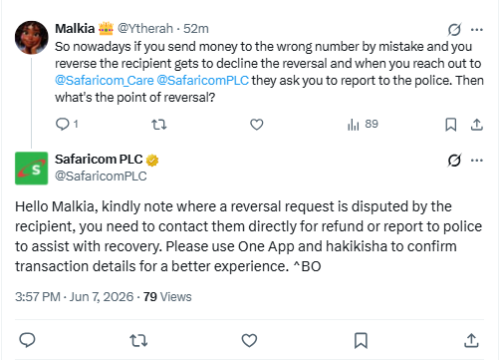
The clarification follows concerns raised on the social media platform X on Sunday, June 7, 2026, where a user identified as Malkia questioned the effectiveness of M-Pesa reversals.
The user noted that in some cases, recipients are able to decline reversal requests, leaving senders uncertain about the next course of action.
You Might Also Like



“So nowadays, if you send money to the wrong number by mistake and you reverse, the recipient gets to decline the reversal, and when you reach out to @Safaricom_Care @SafaricomPLC, they ask you to report to the police. Then what’s the point of reversal?” the X user named Malkia stated.
In response, Safaricom advised that where a reversal request is disputed, customers should first attempt to contact the recipient directly to seek a refund.

Use of police
The company further stated that if this approach fails, users may escalate the matter by reporting to the police to assist in recovery efforts.
Safaricom also emphasised the importance of double-checking transaction details before sending money, encouraging users to utilise tools such as the One App and the “Hakikisha” confirmation feature to reduce cases of erroneous transfers.
“Hello Malkia, kindly note where a reversal request is disputed by the recipient, you need to contact them directly for refund or report to police to assist with recovery. Please use One App and hakikisha to confirm transaction details for a better experience,” Safaricom responded.
The issue highlights ongoing user frustrations around disputed M-Pesa reversals, particularly in cases where funds are sent to incorrect numbers and cannot be automatically retrieved without the recipient’s consent.
M-Pesa remains one of Kenya’s most widely used mobile money platforms, facilitating millions of transactions daily, but cases of mistaken transfers continue to raise concerns about recovery procedures and dispute resolution.
While Safaricom maintains that safeguards exist to minimise errors, the company continues to urge users to exercise caution during transactions to avoid inconvenience and potential financial loss.
MPESA SHA deductions
Over a period of time, users have been taking to social media to air their frustrations about some of their experiences with Safaricom, and the telco has always been coming out to explain the situations in a bid to provide solutions.
In January 2026, Safaricom came out to explain how the Social Health Authority (SHA) can deduct money from users’ M-PESA accounts without prompting them to enter a PIN.
This is after an M-PESA user took to social media on Monday, January 12, 2026, to express concerns after the national health insurer started deducting money directly from his account following his enrolment in the SHA Lipa Mdogo Mdogo service.
The X user, @UCollince, argued that SHA has been deducting money from his account without prompting him to enter an M-PESA PIN.
“Good morning, @SafaricomPLC. Kindly explain how @_shakenya is able to deduct money from our M-Pesa accounts without prompting us to enter our PIN. This started happening after we registered for the Lipa Mdogo Mdogo service. We need clarification on how this authorization works,” he expressed his concerns, demanding an explanation from Safaricom.
Responding to the concerns, the telco explained that the incident can happen if a user has activated M-PESA Ratiba, which is a standing order service on M-PESA, and enabled SHA to auto-deduct.
According to Safaricom, the deduction can happen without prompting for the PIN.
“Hello Collince, apologies for that. If you have activated M-PESA Ratiba, which is a standing order service on M-PESA, and enabled SHA to auto-deduct, this can happen without prompting for the PIN,” Safaricom explained.
Author
Mustafa Juma
View all posts by Mustafa JumaLatest News





Advertisement
More on News