KNBS: How rising food prices are shaping Kenyan shopping baskets despite falling tomato costs
By Aloys Michael, July 2, 2026Kenyan households are changing shopping habits as fluctuating food prices make some groceries cheaper while everyday staples steadily become more expensive.
The latest Consumer Price Indices and Inflation Report by the Kenya National Bureau of Statistics (KNBS) shows that while tomatoes, beans and green grams became cheaper in June, the prices of staple foods, including sukuma wiki, spinach, maize grain, cooking oil and milk, continued to rise, revealing shifting consumer spending patterns amid persistent food inflation
Although Kenya’s annual inflation eased slightly to 6.4 per cent in June 2026 from 6.7 per cent in May, the KNBS report shows food prices remain uneven, with declining costs for some produce overshadowed by persistent increases in essential household staples that many families buy every week.
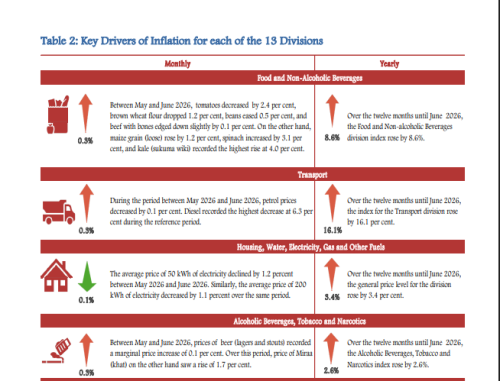
“Between May and June 2026, tomatoes decreased by 2.4 per cent, brown wheat flour dropped 1.2 per cent, beans eased 0.5 per cent, and beef with bones edged down slightly by 0.1 per cent,” KNBS said in the report.
However, the agency noted that maize grain (loose) rose by 1.2 per cent, spinach increased by 3.1 per cent, and kale (sukuma wiki) recorded the highest rise at 4.0 per cent.
The contrasting price movements show how food inflation is becoming increasingly uneven rather than broad-based, with seasonal produce and supply conditions influencing what consumers ultimately place in their shopping baskets.
National average retail prices published by KNBS illustrate the shift. Tomatoes fell from Ksh120.75 per kilogram in May to Ksh117.87 in June, while beans eased to Ksh180.91 per kilogram and green grams declined to Ksh206.45.
Over the same period, the price of sukuma wiki climbed from Ksh110.07 to Ksh114.44 per kilogram, spinach rose to Ksh124.81, maize grain increased to Ksh72.52, cooking oil reached Ksh358.63 per litre, and unpacketed fresh milk edged up to Ksh73.19 per litre.
The monthly changes, however, tell only part of the story. Compared with June last year, many essential food items remain significantly more expensive despite recent price declines.
Purchasing power
KNBS data shows tomatoes cost 40.5 per cent more than a year ago, sukuma wiki has risen by 26.6 per cent, cabbages are up 25.3 per cent, while potatoes have increased by 23.2 per cent. Beef with bones is also 10.2 per cent more expensive than it was a year earlier.
The statistics suggest that temporary monthly price drops are doing little to reverse the longer-term increase in the cost of feeding a household.
The report further shows that food and non-alcoholic beverages recorded annual inflation of 8.6 per cent, remaining among the largest contributors to the country’s overall inflation, alongside transport and housing costs.

Together, the three expenditure categories account for more than 57 per cent of the consumer basket used to calculate inflation.
For consumers, the changing price dynamics are increasingly influencing purchasing decisions. Market traders say shoppers are becoming more selective, often substituting vegetables based on which products are cheapest in a given week.
Retailers are also adjusting procurement strategies to cope with fluctuating wholesale prices, particularly for fresh produce whose supply is heavily influenced by weather conditions and seasonal harvests.
Vegetables such as tomatoes, sukuma wiki and spinach are especially vulnerable to short-term supply shocks. Improved harvests can quickly lower prices, while disruptions caused by rainfall patterns, transport costs or production challenges can trigger equally rapid increases.
Therefore, sustained increases in the prices of vegetables and staple foods may also affect household dietary choices, particularly among lower-income families that already spend a significant proportion of their earnings on food.
As prices rise, consumers may opt for cheaper, less diverse meals, potentially affecting nutritional outcomes over time.