Advertisement
Kenya’s shilling holds steady despite inflation uptick
Saturday 04th April, 2026 07:33 AM|
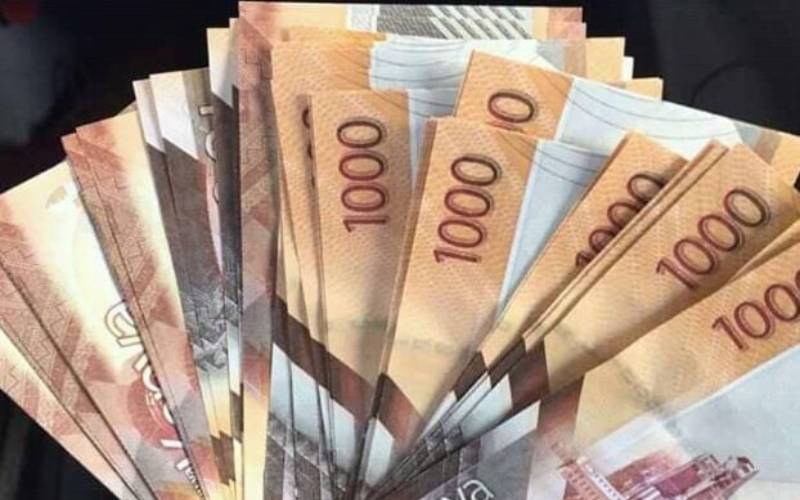
The Kenyan shilling remained broadly stable against major international and regional currencies in the week ending April 2, 2026, even as headline inflation rose slightly in March.
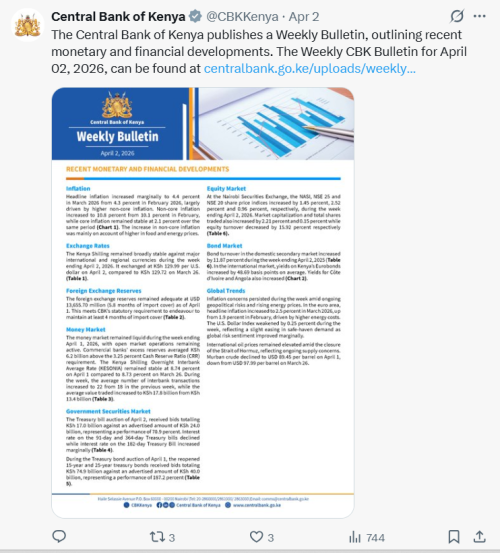
According to the Central Bank of Kenya (CBK) Weekly Bulletin released on April 2, the shilling traded at Ksh129.99 against the US dollar on April 2 compared to Ksh129.72 on March 26.
The local currency also maintained relative stability against other major currencies including the Sterling Pound and the Euro, as well as regional currencies such as the Ugandan, Tanzanian, Rwandese and Burundian shillings.
“Headline inflation increased marginally to 4.4 percent in March 2026 from 4.3 percent in February 2026, largely driven by higher non-core inflation. Non-core inflation increased to 10.8 percent from 10.1 percent in February, while core inflation remained stable at 2.1 percent over the same period,” the Central Bank of Kenya said.
You Might Also Like


Data from the Kenya National Bureau of Statistics shows that headline inflation increased marginally to 4.4 percent in March from 4.3 percent recorded in February.
Inflation rise driven by food and energy
The CBK bulletin indicates that the rise in inflation was mainly driven by an increase in non-core inflation, which rose to 10.8 percent in March from 10.1 percent the previous month.
Non-core inflation includes volatile components such as food and energy prices.
Core inflation, which excludes food and energy items and reflects underlying price trends, remained stable at 2.1 percent during the period. The slight increase in inflation has been linked to seasonal and supply-related pressures affecting food and fuel prices.
Despite the increase, the overall inflation rate remained within the CBK’s target range.
Foreign exchange reserves remain strong
Kenya’s foreign exchange reserves remained stable, providing support for the local currency.
As of April 1, 2026, the country’s reserves stood at Ksh1.77 trillion, equivalent to about 5.8 months of import cover. This level remains above the statutory minimum requirement of four months of import cover.
In the money market, liquidity remained adequate during the week ending April 1. Commercial banks held excess reserves averaging Ksh6.2 billion above the 3.25 per cent cash reserve ratio requirement.
The Kenya Shilling Overnight Interbank Average Rate (KESONIA) remained largely unchanged at 8.74 per cent on April 1 compared to 8.73 per cent the previous week.
Interbank market activity increased during the week, with the average number of transactions rising to 22 from 18 recorded the previous week.
The average value traded also rose to Ksh17.8 billion from Ksh13.4 billion.
Government securities record strong demand
The government securities market also recorded activity during the period.
At the Treasury bill auction held on April 2, bids worth Ksh17 billion were received against an advertised amount of Ksh24 billion, representing a performance rate of 70.9 percent.
Interest rates on the 91-day and 364-day Treasury bills declined slightly, while the 182-day Treasury bill recorded a marginal increase.
Meanwhile, reopened 15-year and 25-year Treasury bonds attracted strong investor interest during the auction held on April 1. The bonds received bids totalling Ksh74.9 billion against an advertised amount of Ksh40 billion, translating to an oversubscription of 187.2 percent.
On the Nairobi Securities Exchange, equity market indicators recorded mixed but generally positive movements during the period, with market capitalisation and turnover reflecting continued investor activity.
Author
Latest News








Advertisement
More on Business