Advertisement
CBK highlights steady inflation, firm market performance
Saturday 01st November, 2025 06:51 AM|

The Central Bank of Kenya (CBK) has highlighted a stable economic landscape with notable developments in inflation, exchange rates, foreign exchange reserves, money market activity, government securities, and the equity market.
The report, released on October 31, 2025, covering the week ending October 30, 2025, provides a comprehensive overview of Kenya’s monetary and financial conditions, signalling resilience amid domestic and regional economic dynamics.
Inflation amid controlled price pressures
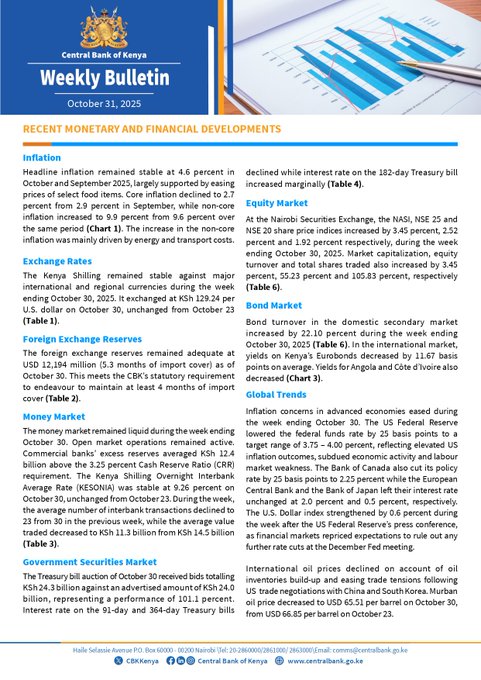
Headline inflation remained steady at 4.6% for both October and September 2025, a trend largely attributed to easing prices of select food items.
Core inflation, which excludes volatile food and energy prices, declined from 2.9% in September to 2.7% in October, reflecting controlled underlying price pressures. However, non-core inflation rose from 9.6% to 9.9%, driven primarily by increased energy and transport costs, indicating areas that may require close monitoring.
You Might Also Like


“Headline inflation remained stable at 4.6 percent in October and September 2025, largely supported by easing prices of select food items. Core inflation declined to 2.7 percent from 2.9 percent in September, while non-core inflation increased to 9.9 percent from 9.6 percent over the same period,” read the report in part.
Stable exchange rate
The Kenyan shilling demonstrated stability against major international and regional currencies, maintaining an exchange rate of Ksh 129.24 per U.S. dollar on October 30, unchanged from the previous week.
“The Kenya Shilling remained stable against major international and regional currencies during the week ending October 30, 2025. It exchanged at KSh 129.24 per U.S. dollar on October 30, unchanged from October 23,” read in part.
This stability is supported by robust foreign exchange reserves, which stood at USD 12.19 billion as of October 30. The reserves provide 5.3 months of import cover, exceeding the CBK’s statutory minimum requirement of 4 months, ensuring a strong buffer against external shocks.
The money market remained liquid, with commercial banks holding excess reserves averaging Ksh 12.4 billion above the 3.25% Cash Reserve Ratio (CRR). The Kenya Shilling Overnight Interbank Average Rate (KESONIA) held steady at 9.26%, though interbank transactions dropped to an average of 23 from 30 the previous week, with the traded value declining from Ksh 14.5 billion to Ksh 11.3 billion.
This points to a slight contraction in interbank activity, possibly due to seasonal factors or liquidity management.
Author
Latest News








Advertisement
More on Business