Advertisement
Kenya Railways cancels World Bank-funded tender for multiple-unit diesel trains
Tuesday 28th April, 2026 08:05 PM|
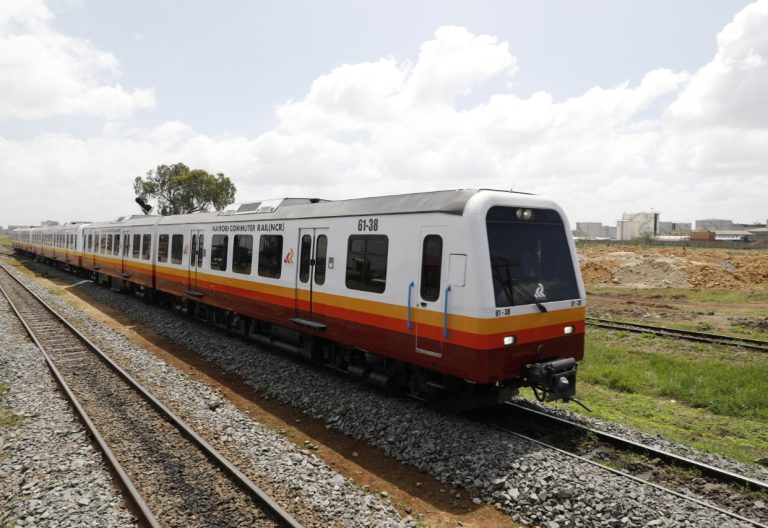
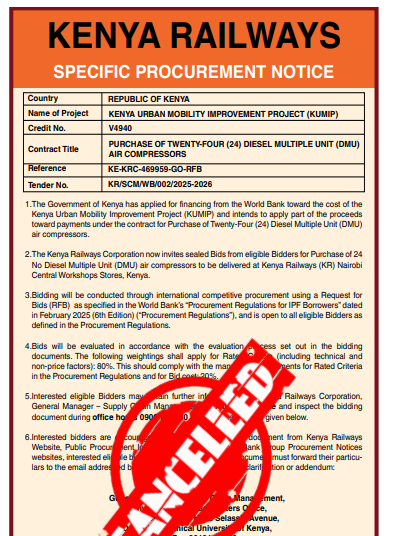
Kenya Railways has cancelled a World Bank-funded tender for 24 air compressors meant for its Diesel Multiple Unit (DMU) trains, halting a procurement process that was expected to support Nairobi’s commuter rail operations.
The corporation issued the cancellation notice on Tuesday, April 28, 2026, just 12 days before the bid submission deadline of May 11, 2026. The notice did not give any explanation.
The tender formed part of the Kenya Urban Mobility Improvement Project (KUMIP), a Ksh65 billion programme financed by the World Bank to modernise commuter rail and urban transport in Nairobi and surrounding towns.
The compressors were meant for delivery to the Nairobi Central Workshops, where Kenya Railways maintains its DMU fleet. The procurement followed an international competitive process under World Bank rules, with bidders required to submit a Ksh1.5 million bid security.
You Might Also Like



Kenya Railways has not said whether it will re-advertise the tender or revise the specifications.
The air compressors form part of the DMU train’s core systems. They generate compressed air used in braking, door operations and other pneumatic functions. Without them, the trains cannot operate safely.
The cancelled tender was intended to replace worn-out units in a fleet that has become central to Nairobi’s commuter rail service. The DMUs run daily on routes including Syokimau, Thika, Kikuyu and Kitengela, carrying thousands of passengers into and out of the city.
Kenya Railways bought the 11 five-car DMU sets second-hand from Spain in 2020 at a cost of about Ksh1.5 billion. The trains reduced travel times and offered a cheaper alternative to road transport, but they have also required frequent maintenance at the Nairobi Central Workshops.
Maintenance pressure and breakdown concerns
The decision to cancel the tender comes against a background of ongoing debate over the condition of the DMU fleet.
Earlier reports claimed that most of the trains had broken down, with only one operational. Kenya Railways rejected those claims, stating that all 11 units remain operational and undergo routine maintenance.
“Whereas Kenya Railways appreciates the interest of the reporter in informing the public, it is evident that the information is not a factual representation of the Railway Standard Operating Procedures,” the corporation said.
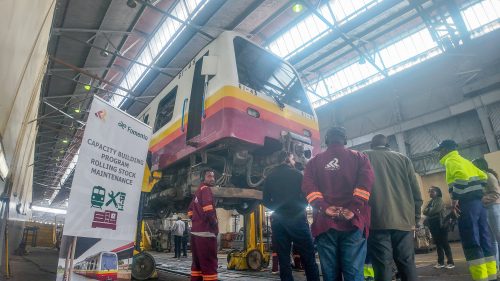
It added that DMUs are regularly recalled for scheduled maintenance at the Nairobi Railway Central Workshop and continue to run daily services.
The corporation also confirmed that it is planning to acquire higher capacity Diesel Electric Multiple Units (DEMUs) under the second phase of its commuter rail master plan.
What led to the cancellation
Kenya Railways has not provided a reason for cancelling the compressor tender. However, the timing and procurement records show that the process was still at the bidding stage, with submissions due in mid-May 2026.
The cancellation stopped the process before bid opening, meaning no contractor had been selected.
The procurement was part of a World Bank-funded upgrade aimed at improving reliability of the commuter rail system. The compressors were listed as essential replacement parts for continued DMU operations.
Officials have not indicated whether the cancellation was triggered by technical review, budget adjustment, or changes to specifications.
Impact on commuter rail operations
The DMU trains form the backbone of Nairobi’s commuter rail service. They have reduced travel time between the city and satellite towns and eased pressure on roads during peak hours.
The network has expanded in recent years with new stations along the Nairobi–Ruiru corridor, including Ruiru, Kenyatta University, Kahawa West, Githurai, Mwiki, Dandora and Mutindwa. The expansion formed part of a broader plan to integrate rail transport with urban mobility systems.
However, the reliability of the service depends heavily on maintenance. The compressors are among the components that wear out under daily use, and delays in replacement can force trains out of service for repairs.
Workshop teams at Nairobi Central continue to service the fleet, but ageing components have increased maintenance costs and downtime.
The cancelled tender was financed under the Kenya Urban Mobility Improvement Project, which the World Bank approved as part of a $500 million (about Ksh65 billion) loan to Kenya.
The project aims to upgrade commuter rail infrastructure, improve stations, modernise operations and support integrated transport systems in Nairobi.
The compressor procurement was a small but essential part of that programme, focused on keeping existing trains operational while larger upgrades are developed.
The cancellation leaves a gap in a system already under pressure from high passenger demand and ageing rolling stock. The DMU fleet remains central to Nairobi’s commuter rail service, but its performance now depends on how quickly Kenya Railways resolves the stalled procurement.
This comes at a time when Kenya and the UK are working to build the Nairobi Railway City, which is touted to transform the city.
Author
Kenneth Mwenda
Kenneth Mwenda is a business, sports, and politics digital writer with over seven years of experience in journalism, covering breaking news, feature stories, and in-depth analysis across a range of beats.
For inquiries, he can be reached at [email protected]
View all posts by Kenneth MwendaLatest News



Advertisement
More on Business