Advertisement
Willis Otieno: Political outrage means nothing if MPs fail to show up for key votes
Saturday 20th June, 2026 08:11 AM|

Safina Party Deputy Leader and lawyer Willis Otieno has intensified his criticism of Kenya’s political class, warning that democracy is being weakened by a widening gap between public rhetoric and actual participation in key legislative decisions.
In a statement shared on his official X account on Saturday, June 20, 2026, Otieno said leadership must be defined by presence and accountability, especially during moments when Parliament is making decisions that directly affect citizens’ livelihoods.
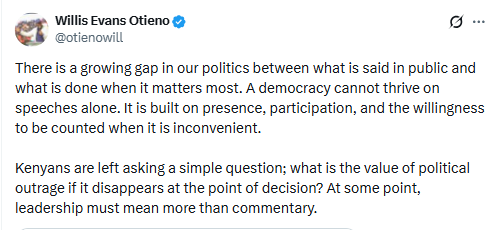
“There is a growing gap in our politics between what is said in public and what is done when it matters most,” Otieno said.
“A democracy cannot thrive on speeches alone. It is built on presence, participation, and the willingness to be counted when it is inconvenient.”
You Might Also Like
He added that Kenyans were increasingly questioning the value of political outrage when some leaders fail to participate in decisive votes.
“Kenyans are left asking a simple question; what is the value of political outrage if it disappears at the point of decision? At some point, leadership must mean more than commentary,” he stated.
Heated exchange over Finance Bill vote
Otieno’s latest comments come hours after he launched a sharp attack on Kiharu Member of Parliament (MP) Ndindi Nyoro following the legislator’s explanation for missing the vote on the Finance Bill 2026.
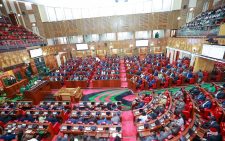
The controversial Bill was passed by the National Assembly after 122 MPs voted in support and 40 opposed it, paving the way for its transmission to President William Ruto for assent. However, only 162 out of 349 MPs participated in the vote, raising concerns over absenteeism during a critical economic decision.
Otieno accused Nyoro of abandoning Kenyans at a decisive moment despite months of vocal criticism of the government’s fiscal policies.
In a strongly worded post, Otieno questioned the MP’s consistency and political sincerity.
“Buda, usitubebe ufala,” he wrote.
“It is becoming a recurring pattern that whenever Parliament is confronted with consequential votes that directly affect the livelihoods of millions of Kenyans, you are conveniently outside the country.”
Otieno further argued that Nyoro’s absence undermined his previous public opposition to the Finance Bill and raised doubts about whether his political activism was genuine.
“After months of fiery rhetoric, media appearances, and vehement opposition to the Finance Bill, your conspicuous absence at the decisive moment raises legitimate questions about your sincerity and political fortitude,” he said.
“Were the interviews merely performative? Was the outrage simply a public relations exercise?”
His remarks sparked widespread debate online, with Kenyans divided over whether elected leaders should be held to a higher standard of parliamentary attendance, especially on major fiscal legislation.
Ndindi Nyoro responds to absence claims
In response, Nyoro acknowledged missing the vote and expressed regret over his absence, explaining that he had travelled out of the country on urgent commitments.
“The vote for the Finance Bill happened yesterday; disappointingly, I was not in Parliament. I travelled out of the country on Wednesday evening for engagements that could not have been postponed. No explanation should absolve the blame,” Nyoro said in a statement shared on Friday, June 19, 2026.

He added that he had reviewed public feedback and accepted criticism from Kenyans over his absence.
“As for the feedback we have received from all Kenyans, we take it with humility,” he said.
Nyoro defends parliamentary record
Despite the criticism, Nyoro defended his broader parliamentary record, insisting that he has consistently participated in key debates on fiscal policy, including both the Finance Bill and the Appropriations Bill.
He also pointed to what he described as structural challenges within Parliament, arguing that effective oversight has been weakened by political alignment across the House.
“Parliament is in an unprecedented phase where both the Majority and the Minority leadership are on the same side, thereby making it difficult to effectively act as an institution of oversight,” he said.
Nyoro further highlighted past interventions on national policy debates, including opposition to proposed increases in secondary school fees and scrutiny of government plans to sell a stake in Safaricom, arguing that public pressure had influenced policy reversals in some instances.
Author
Mustafa Juma
View all posts by Mustafa JumaLatest News


Advertisement
More on Inside Politics