Advertisement
Salasya explains opposition to Finance Bill 2026, calls for review of 2024 Finance Act
Saturday 20th June, 2026 07:48 AM|

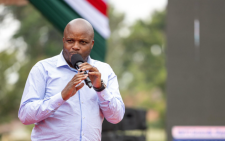
Mumias East Member of Parliament (MP) Peter Salasya has explained why he opposed the Finance Bill 2026.
The lawmaker argues that the legislation presented a missed opportunity for the government to revisit and review the controversial Finance Act 2024 through a fresh public participation process.
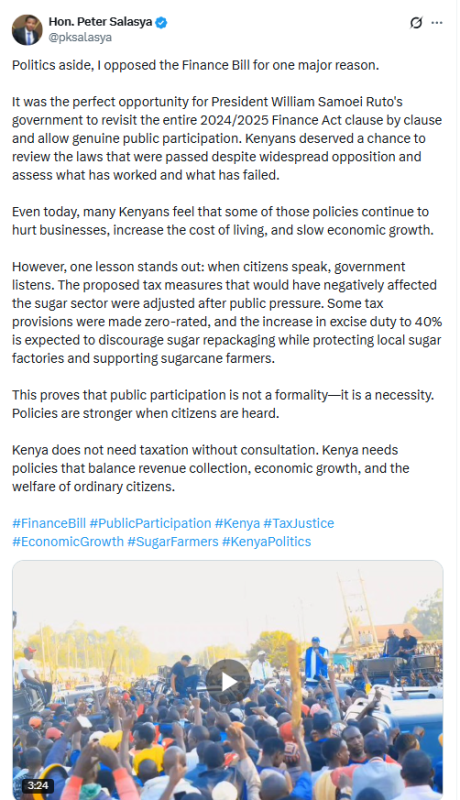
In a statement shared on his official X account on Saturday, June 20, 2026, Salasya said his opposition to the Bill was not driven by politics but by what he described as the need to reassess tax measures that many Kenyans still believe are hurting businesses, increasing the cost of living, and slowing economic growth.
“Politics aside, I opposed the Finance Bill for one major reason,” Salasya said.
You Might Also Like


“It was the perfect opportunity for President William Ruto’s government to revisit the entire 2024/2025 Finance Act clause by clause and allow genuine public participation. Kenyans deserved a chance to review the laws that were passed despite widespread opposition and assess what has worked and what has failed.”
Calls for review of controversial tax measures
The outspoken legislator argued that concerns surrounding the Finance Act 2024 have not disappeared despite the passage of time, noting that many citizens continue to feel the impact of some of the policies introduced under the law.
According to Salasya, Parliament and the Executive should have used the Finance Bill 2026 process to evaluate the effectiveness of the previous tax regime and determine whether certain provisions should be retained, amended, or repealed.
“Even today, many Kenyans feel that some of those policies continue to hurt businesses, increase the cost of living, and slow economic growth,” he said.
The Finance Act 2024 sparked nationwide debate and protests after critics accused the government of imposing a heavy tax burden on households and businesses already grappling with economic challenges.
Public pressure influenced changes
Despite opposing the Bill, Salasya acknowledged that public participation had influenced some of the final proposals adopted by lawmakers.
He pointed to changes affecting the sugar sector as evidence that citizen engagement can shape government policy.
According to the MP, proposals that would have negatively affected sugar farmers and local factories were adjusted after concerns were raised by stakeholders and members of the public.
“The proposed tax measures that would have negatively affected the sugar sector were adjusted after public pressure,” Salasya noted.
He added that some tax provisions were made zero-rated, while the proposed increase in excise duty to 40 per cent is expected to discourage sugar repackaging practices and protect local sugar millers.
The legislator argued that the changes demonstrated the value of public involvement in policy-making.
“This proves that public participation is not a formality—it is a necessity. Policies are stronger when citizens are heard,” he said.
Debate over Finance Bill 2026
Salasya’s remarks come days after the National Assembly passed the Finance Bill 2026 following weeks of public debate and scrutiny.
The Bill sailed through its Third Reading with 122 MPs voting in favour and 40 voting against, paving the way for transmission to President William Ruto for assent.
The legislation is expected to play a central role in financing the government’s Ksh4.8 trillion budget for the 2026/27 financial year through various tax and revenue measures.
Supporters of the Bill argue that it will strengthen domestic revenue collection and reduce reliance on borrowing, while critics maintain that some provisions could increase the financial burden on ordinary Kenyans.
With concerns over the cost of living remaining a major political issue, the debate surrounding the Finance Act 2024 and the newly passed Finance Bill 2026 is likely to continue in the months ahead.
Author
Mustafa Juma
View all posts by Mustafa JumaLatest News


Advertisement
More on Inside Politics