Advertisement
UN report: Kenya’s future borrowing could stay costly despite improving global markets
Saturday 20th June, 2026 12:36 AM|

Kenya’s efforts to refinance maturing debt and raise fresh funds from international markets could remain expensive despite an improving global financial environment, a new United Nations report has warned.
The report by the United Nations Conference on Trade and Development (UNCTAD) shows that while global borrowing conditions have eased over the past year, African countries continue to face significantly higher debt costs than their counterparts in developed economies, raising concerns about the long-term impact on public finances and development spending.
The findings come as Kenya continues managing a heavy debt-servicing burden and prepares for future borrowing to finance budget deficits, infrastructure projects and refinancing obligations.
For instance, Treasury Cabinet Secretary John Mbadi has said that, on financing the deficit, Kenya remains constrained by both external and domestic borrowing challenges.
You Might Also Like



“Deficit can only be financed through borrowing, both domestic and external,” he said, adding that global financial conditions are increasingly unfavourable.
“External borrowing is not very certain. We are not getting concessional loans easily because Kenya is now seen as a developing economy with the capacity to access commercial funding. But the macro environment globally is not good; high inflation, disruptions and shocks mean investors are asking for more money.”
He added that commercial borrowing has become more expensive, while domestic borrowing carries its own risks.
“When you come to domestic borrowing, you crowd out the private sector and interest rates start rising. So we are balancing these two,” he said.
The Treasury has projected about Ksh116 billion in external borrowing, with the remainder expected from domestic sources, though Mbadi hinted at ongoing negotiations with financial partners that could ease pressure on the local market.
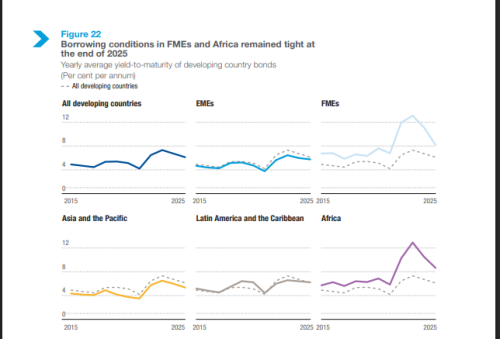
According to UNCTAD, average borrowing yields for developing countries fell from a peak of 7.3 per cent in 2023 to 5.7 per cent in 2025 as major central banks in advanced economies began cutting interest rates and investors returned to emerging markets.
However, African countries have not enjoyed the same level of relief.
“In 2025, the average coupon rate for all developing countries stood at 5.8 per cent, with significantly higher rates, close to 8 per cent, for frontier market economies and African sovereigns,” the report says.
The findings suggest that although international financial markets are becoming more favourable, countries such as Kenya could still face elevated borrowing costs when they return to global debt markets.
The Eurobond loan
For Kenya, which has increasingly relied on Eurobonds and syndicated loans to finance development and refinance existing obligations, higher borrowing costs translate directly into larger debt repayments and reduced fiscal flexibility.
The report notes that African countries were among the hardest hit during the global monetary tightening cycle that followed the COVID-19 pandemic.
“Following the COVID-19 pandemic shock and subsequent global monetary tightening, yields in developing countries surged. The increase was especially dramatic for frontier market economies and African countries, where average yields nearly doubled to 12 per cent and 11 per cent, respectively,” UNCTAD says.
Although borrowing costs have moderated since then, African nations continue paying a significant risk premium compared to developed economies.
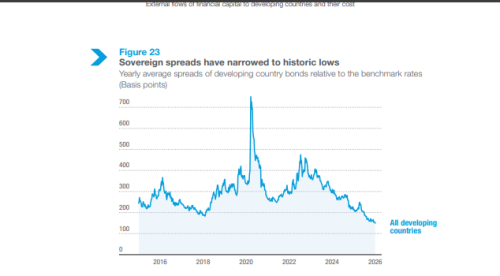
In 2025, developing countries still paid an average borrowing premium of 1.9 percentage points above benchmark rates in advanced economies, highlighting what UNCTAD describes as a persistent financing gap between rich and developing nations.
The concern for Kenya is that expensive borrowing today can lock governments into years of elevated repayments.
“Coupon rates do not adjust after issuance and therefore lock countries into long-term financing costs determined at a specific moment in time,” the report states.
This means debt contracted when rates are high continues attracting costly interest payments even after global borrowing conditions improve.
UNCTAD also found that maturities on newly issued foreign-currency bonds have shortened sharply, falling from an average of about 17 years between 2015 and 2021 to just 9.5 years in 2025.

The shorter repayment periods increase refinancing risks because governments must return to financial markets more frequently to roll over debt.
“Shrinking maturities heighten vulnerabilities and undermine governments’ abilities to finance long-term development,” the report warns.
For Kenya, this could complicate future Eurobond issuances and increase pressure on Treasury officials seeking to balance debt repayments with spending on healthcare, education, infrastructure and social programmes.
The report further highlights the growing strain that debt servicing is placing on developing-country budgets. Between 2014 and 2024, interest payments on government debt in developing countries increased by 102 per cent while government revenues rose by only 39 per cent.
As a result, 73 per cent of developing countries experienced a decline in fiscal space between 2018 and 2024, meaning governments had less money available for development priorities after meeting debt obligations.
UNCTAD warns that even though interest rates are falling globally, countries that borrowed during the period of monetary tightening will continue to feel the effects for years.
“Borrowing contracted during the tightening phase is locking in higher costs, constraining fiscal space and risking the crowding out of development spending in the years ahead,” the report says.
Author
Latest News






Advertisement
More on Business