Advertisement
Njeri Maina calls on LSK to pursue more than court boycott over judiciary concerns
Tuesday 21st July, 2026 01:29 AM|

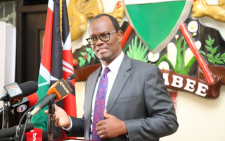
Kirinyaga Woman Representative and High Court advocate Njeri Maina has called on the Law Society of Kenya (LSK) to pursue broader reforms within the justice system, saying a planned nationwide court boycott alone will not resolve the challenges facing the Judiciary.
Speaking during an interview on Monday, July 20, 2026, Maina said advocates have a right to withdraw their services in protest but urged the society to use all available accountability mechanisms to address concerns over corruption, delays, and public confidence in the courts.
“The LSK is a body of advocates and they have every right to boycott court sessions as we look for solutions. Is it going to just magically be solved just because we boycott court sessions? Certainly not,” she said.
“We have JSC, we have other avenues. I do believe we should be pursuing them, and we should be relentless in it… the LSK I believe should do more than just boycott court.”
Judiciary dispute over reforms
You Might Also Like


Maina’s remarks come ahead of the LSK’s planned nationwide boycott of court proceedings on Wednesday, July 22, 2026, announced over concerns including corruption, registry inefficiencies, delays in the administration of justice and declining public confidence in the Judiciary.
Under the plan, advocates will stay away from court sessions while continuing to file documents within statutory timelines.
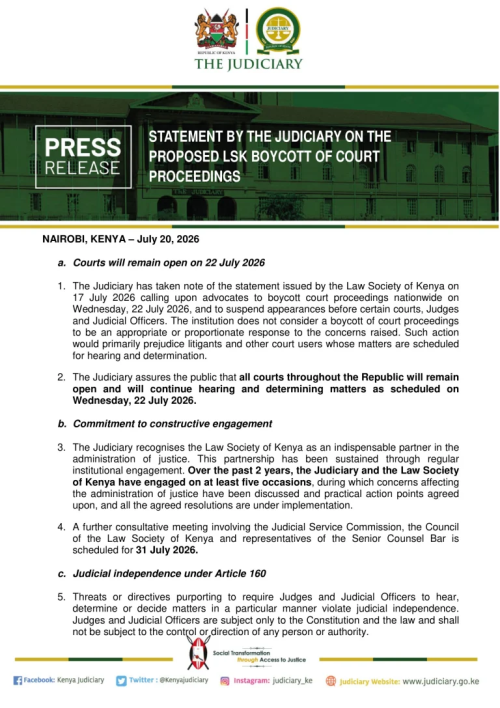
The Judiciary has maintained that courts will remain open, saying the boycott is neither appropriate nor proportionate. It has instead called for dialogue through existing institutional frameworks, including a meeting with the Judicial Service Commission (JSC) scheduled for July 31.
Maina said meaningful reforms require sustained engagement with constitutional institutions rather than relying solely on industrial action.
Judiciary reflects wider society
The legislator acknowledged that the Judiciary faces genuine challenges, saying corruption exists within the institution but should be addressed through established oversight mechanisms.
“I have said the judiciary is not without fault. It’s not a perfect judiciary. Are there instances of corruption? Yes. Is it extensive in some cases? Yes,” she said.
Maina argued that the Judiciary mirrors broader societal challenges, adding that restoring confidence in the justice system requires changes beyond the courts. “It is the system… the system is just a bit broken in some ways,” she said.

“We are morally depraved as Kenyans… we seem to be denigrating as a society in terms of our morality.”
She called for greater use of institutions such as the JSC and the Office of the Judiciary Ombudsman to handle complaints against judges and judicial officers.
Access to justice
While recognising the LSK’s right to protest, Maina cautioned that prolonged disruption of court services could affect ordinary Kenyans seeking urgent legal remedies, including bail and bond applications.
She said reforms should protect both judicial accountability and uninterrupted access to justice.
Her comments come days after she participated in campaigns during the Ol Kalou parliamentary by-election, where she also spoke about governance, electoral integrity and institutional accountability.
Maina maintained that lasting change will depend on strengthening oversight institutions and pursuing reforms through constitutional processes, while preserving public confidence in Kenya’s justice system.
Author
Latest News







Advertisement
More on Inside Politics