Advertisement
Judiciary breaks silence on LSK boycott, confirms all courts will remain open
Monday 20th July, 2026 05:54 PM|

The Judiciary has assured Kenyans that all courts across the country will remain open and continue hearing cases as scheduled on Wednesday, July 22, 2026, despite a nationwide boycott of court proceedings called by the Law Society of Kenya (LSK).
In a statement issued on Monday, July 20, Judiciary Spokesperson Paul Ndemo said the institution had taken note of the LSK’s decision but maintained that boycotting court proceedings was neither an appropriate nor proportionate response to the concerns raised by the lawyers’ body.
“The Judiciary assures the public that all courts throughout the Republic will remain open and will continue hearing and determining matters as scheduled on Wednesday, 22 July 2026,” Ndemo said.
He warned that the proposed boycott would primarily hurt litigants and other court users whose cases are already scheduled for hearing.
Judiciary urges litigants to attend court
You Might Also Like



The Judiciary urged members of the public, advocates and litigants to report to court as scheduled, emphasising that judicial services would continue uninterrupted despite the planned industrial action by lawyers.
The institution also appealed to the LSK to reconsider its decision and instead pursue dialogue through existing consultative mechanisms.
According to the statement, the Judiciary and the LSK have held at least five institutional engagements over the past two years, during which several concerns affecting the administration of justice were discussed, and action points agreed upon.
The Judiciary further revealed that another consultative meeting involving the Judicial Service Commission (JSC), the Council of the Law Society of Kenya, and representatives of the Senior Counsel Bar has already been scheduled for July 31, 2026.
LSK boycott
The Judiciary’s statement comes days after the Law Society of Kenya, under President Charles Kanjama, announced a nationwide boycott of court proceedings on Wednesday, July 22, 2026.
In a statement issued on July 17, 2026, the lawyers’ body directed advocates across the country to stay away from court sessions and also announced an indefinite suspension of appearances before certain courts and judicial officers.

The Society said the boycott was intended to underscore what it described as persistent concerns over the administration of justice, including allegations of judicial corruption, misconduct, registry inefficiencies, delays in case determination and declining public confidence in some judicial processes.
While advocates will suspend appearances in court, the LSK indicated that lawyers would continue filing pleadings and other documents within statutory timelines.
Judiciary defends judicial independence
In Monday’s response, the Judiciary strongly defended the constitutional independence of judges and judicial officers.
Ndemo stressed that judges are bound only by the Constitution and the law and cannot be directed by any individual or institution on how to decide cases.
“Threats or directives purporting to require Judges and Judicial Officers to hear, determine or decide matters in a particular manner violate judicial independence,” the statement said.
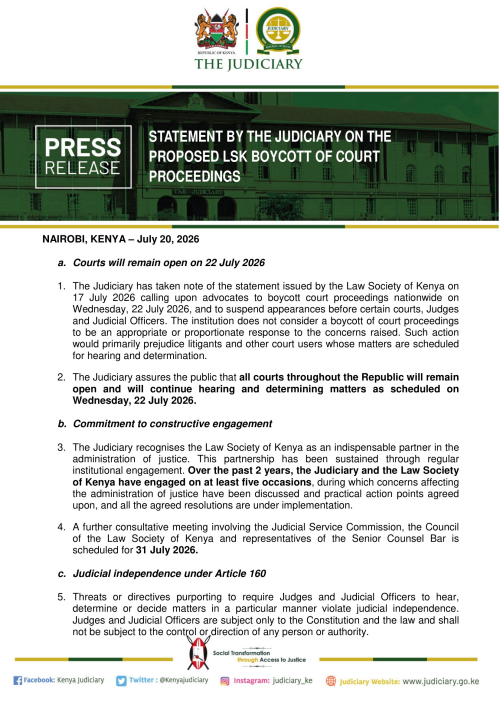
The Judiciary cited Article 160 of the Constitution, which guarantees judicial independence and shields judges from external influence in the discharge of their duties.
Existing channels for complaints
The Judiciary also reminded the public that complaints against judges, judicial officers and Judiciary staff should be lodged through the Judicial Service Commission or the Office of the Judiciary Ombudsman.
According to the statement, any complaints received are investigated fairly and transparently, with disciplinary action taken where misconduct is established.
At the same time, the institution emphasised that judges and judicial officers are entitled to due process and that public accusations cannot replace constitutionally established disciplinary procedures.
Call for dialogue
Even as the standoff escalates, the Judiciary maintained that dialogue remains the best avenue for resolving disagreements.
The institution said it remains committed to constructive engagement with the Law Society of Kenya and other justice-sector stakeholders, urging lawyers to abandon the planned boycott and instead utilise the structured consultation mechanisms already in place.
With both sides holding firm to their positions, attention will now shift to Wednesday, July 22, when courts are expected to operate normally even as advocates across the country prepare to stage their nationwide boycott.
Author
Mustafa Juma
View all posts by Mustafa JumaLatest News







Advertisement
More on News