Advertisement
Women-owned SMEs emerge as lower-risk borrowers despite financing gaps
Tuesday 21st July, 2026 01:42 AM|

Women-owned small and medium-sized enterprises (SMEs) in emerging markets continue to outperform the broader SME sector in loan repayment performance despite receiving significantly less financing, according to new data released by the International Finance Corporation (IFC).
The findings, published in July 2026, are based on nearly a decade of sex-disaggregated data collected from IFC client financial institutions and reinforce the business case for increasing investment in women entrepreneurs.
Data from 153 financial institutions in 2024 showed that women-owned SMEs recorded a non-performing loan (NPL) ratio of 3.6 per cent, compared with 3.8 per cent for the overall SME portfolio. IFC said the stronger repayment performance has remained consistent over the past 10 years, positioning women-owned SMEs as a lower-risk asset class for lenders.
The report also found that despite this track record, women-owned businesses continue to experience limited access to finance across emerging markets.
Credit gap persists despite strong repayment record
You Might Also Like



According to the IFC, women-owned SMEs represent more than one-third of all micro, small and medium-sized enterprises in emerging markets, yet account for only 19 per cent of outstanding SME loan volumes and 27 per cent of the total number of SME loans issued by surveyed financial institutions.
In addition, the average loan extended to a woman-owned SME is 28 per cent smaller than the average SME loan.
The report attributes the financing gap to factors including limited collateral, shorter credit histories, weaker digital footprints, legal and policy barriers, and financial products that do not adequately match the needs of women entrepreneurs.
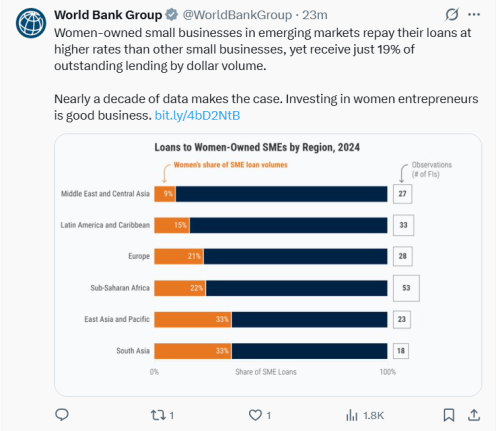
Across 119 emerging markets and developing economies, the formal financing gap for micro, small and medium-sized enterprises remains in the trillions of dollars.
Regional disparities also remain significant. While women-owned SMEs accounted for roughly one-third of SME loan volumes among reporting financial institutions in Asia, the figure stood at just 9 per cent in the Middle East and Central Asia.
Tailored banking strategies show stronger results
The IFC found that financial institutions with dedicated strategies targeting women-owned businesses recorded stronger growth than those without such programmes.
Among 51 financial institutions participating in IFC’s Banking on Women programme, 75 per cent increased the share of women-owned SMEs in their loan portfolios. By comparison, only 48 per cent of institutions without a dedicated strategy recorded similar growth.
Since 2012, IFC’s Banking on Women initiative has provided more than Ksh1.73 trillion in financing and advisory support to 357 financial institutions across 87 emerging markets.
The programme also supports financial institutions in collecting and analysing sex-disaggregated data to help design products tailored to women entrepreneurs.
Kenya steps up support for women entrepreneurs
The report comes as Kenya continues expanding financing programmes targeting women-owned businesses.
During a women empowerment event in Homa Bay County on June 26, 2026, Treasury Cabinet Secretary John Mbadi reaffirmed the government’s commitment to supporting women entrepreneurs through initiatives under the Bottom-Up Economic Transformation Agenda (BETA).
Funding in the 2026/27 Budget has been allocated to programmes including the Women Enterprise Fund, the National Government Affirmative Action Fund and the Hustler Fund, which support affordable credit, business development, skills training and market access for women operating in agriculture, trade and services.
The IFC said its findings demonstrate that better use of sex-disaggregated data enables financial institutions to understand women-owned businesses more effectively, develop tailored financial products and expand lending to a customer segment that has consistently demonstrated strong repayment performance.
Author
Latest News








Advertisement
More on Business