Advertisement
World Bank: Kenya’s economy to grow 4.3% despite debt and drought risks
Wednesday 15th July, 2026 05:26 PM|

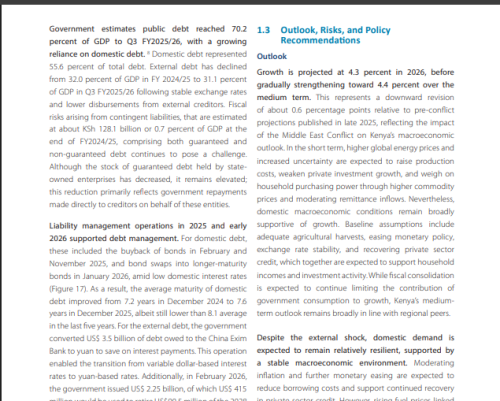
Kenya’s economy is expected to grow by 4.3 per cent in 2026 despite elevated public debt, drought risks, revenue shortfalls and the economic fallout from conflict in the Middle East, according to the latest World Bank assessment.
The forecast follows an estimated 4.6 per cent expansion in 2025 and reinforces Kenya’s reputation as one of Africa’s most resilient economies. For investors, businesses and households searching for answers about Kenya’s economic growth.
The World Bank’s latest Kenya GDP growth forecast comes at a time when many emerging economies are grappling with slowing growth, geopolitical uncertainty and tighter fiscal conditions. Yet Kenya’s economic outlook remains broadly positive.
“Domestic macroeconomic conditions remain broadly supportive of growth, reflecting stable exchange rates, easing monetary policy, recovering private sector credit and expectations of improved agricultural performance. These factors have strengthened Kenya’s economic resilience even as the country confronts higher fuel prices, fiscal pressures and climate-related risks,” the report observes.
Growth drivers
You Might Also Like



The World Bank identifies the services sector as the primary engine of Kenya’s economic growth.
“Services are projected to remain the main driver of growth,” the report states, with the sector expected to expand by about 5.4 per cent on average during 2026 and 2027. Information and communication technology, financial services, tourism, transport and trade continue to support business activity, investment and employment.
The expansion of digital services and financial innovation has also helped diversify economic activity and reduce dependence on any single sector.
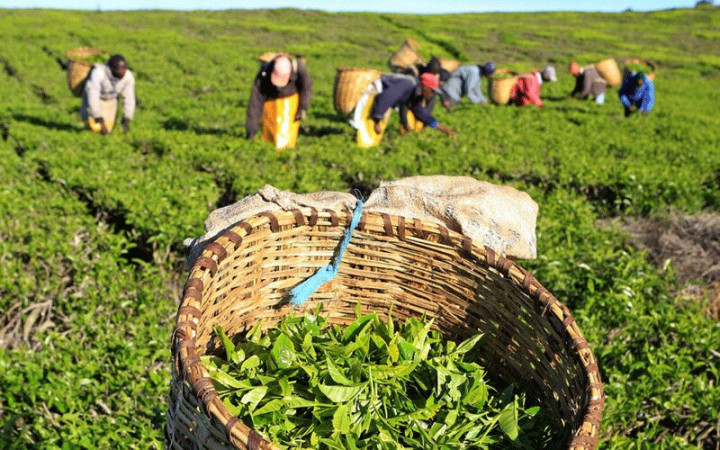
Agriculture remains another critical Kenya growth driver despite recurring concerns over drought and climate variability. The World Bank projects agricultural growth of 4.2 per cent in 2026, rising to 4.9 per cent in 2027, supported by favourable weather conditions and adequate agricultural inputs. Stronger agricultural output is expected to improve rural incomes, strengthen food security and support household consumption.
At the same time, lower interest rates and moderating inflation are expected to reduce borrowing costs, encourage investment and accelerate private sector credit growth. Together, these factors are creating a more supportive environment for businesses and consumers, helping sustain economic momentum.
Risks ahead
The World Bank cautions that significant risks remain. The conflict in the Middle East has emerged as a major external threat, increasing fuel prices, raising production costs and creating broader economic uncertainty.
“The conflict in the Middle East weighed on Kenya’s macroeconomic performance through multiple transmission channels,” the report notes.
Higher energy costs have increased pressure on businesses and households while also contributing to inflationary risks.
Domestic fiscal challenges also continue to weigh on the Kenyan economy outlook. Public debt reached 70.2 per cent of GDP by the third quarter of the 2025/26 fiscal year, while revenue collection shortfalls have constrained government finances.
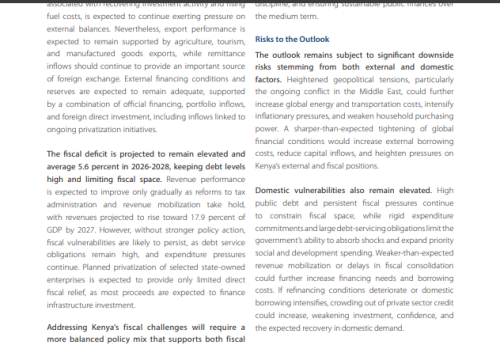
“High public debt and persistent fiscal pressures continue to constrain fiscal space, limiting the government’s ability to respond to future shocks. Sustaining growth will therefore depend on continued fiscal reforms, improved revenue mobilisation, stronger expenditure controls and enhanced transparency,” the World Bank states.
Despite these challenges, the report concludes that Kenya’s growth fundamentals remain intact. A diversified economy, a strong services sector, a recovering agriculture sector, improving credit conditions, and stable macroeconomic management continue to support expansion.
For those asking whether Kenya’s economy is growing, what drives Kenya’s GDP, or how resilient Kenya is compared to other African economies, the World Bank’s answer is clear: Kenya continues to demonstrate economic resilience by maintaining growth above 4 per cent despite debt pressures, drought risks and global shocks, positioning the country for sustained expansion in the years ahead.
Author
Latest News





Advertisement
More on Business