Advertisement
Kenya Power faces market competition as KenGen initiates private licensing bid
Wednesday 27th May, 2026 07:45 AM|

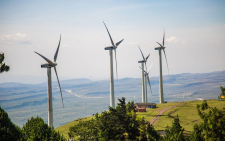
Kenya Electricity Generating Company PLC (KenGen) has formally initiated plans that could significantly weaken the long-held electricity distribution dominance of Kenya Power (KP) after publishing a public notice seeking electricity transmission and distribution licences for the proposed KenGen Green Energy Park.
In the notice on Tuesday, May 26, 2026, under Section 119(3) of the Energy Act, 2019, KenGen said it will, on June 2, 2026, make an application to the Energy and Petroleum Regulatory Authority (EPRA) for the Electric Power Transmission and Distribution Licenses for KenGen Green Energy Park.
The move signals a major shift in Kenya’s electricity sector, where Kenya Power has historically maintained a near-monopoly over power distribution and retail supply.
“The grant of the Licenses will not have any adverse effect on public or local authorities, companies, persons or bodies of persons within the areas of the undertaking,” KenGen stated.
You Might Also Like
The announcement opens the door for KenGen, traditionally a power producer, to expand directly into transmission and distribution, roles largely associated with Kenya Power.
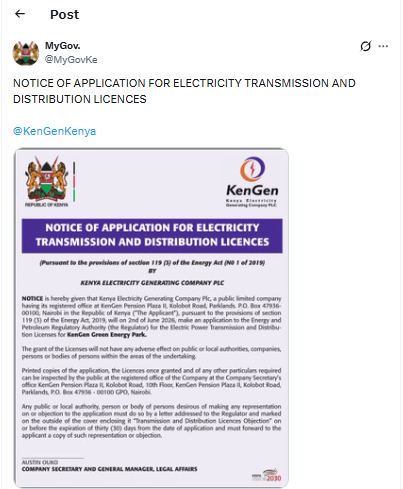
The notice also invited objections from the public and stakeholders.
“Any public or local authority, person or body of persons desirous of making any representation on or objection to the application must do so, within thirty (30) days from the date of application,” the notice read.
The development comes just days after EPRA announced new electricity tariff adjustments that will increase consumer power bills in April 2026.
EPRA introduced three additional charges: a Fuel Energy Cost Charge of 347 Kenya cents per kWh, a Foreign Exchange Fluctuation Adjustment of 123.41 cents per kWh, and a water-related levy of 1.54 cents per kWh.
“All prices for electrical energy specified in the Schedule of Tariffs will be liable to a Fuel Energy Cost Charge of plus 347 Kenya cents per kWh for all meter readings taken in April 2026,” EPRA Acting Director-General Joseph Oketch said.

The regulator attributed the increase to rising thermal generation costs, foreign exchange losses, and hydropower-related levies.
According to EPRA, Independent Power Producers accounted for the largest forex-related losses at Ksh874.78 million, while Kenya Power recorded Ksh453.2 million in adjustments.
Consumers in off-grid counties, including Mandera, Wajir, Marsabit, Turkana, and Lamu, are expected to feel the heaviest burden due to high diesel generation costs.
“These adjustments are necessary to align electricity prices with the actual cost of generation and foreign exchange movements,” EPRA defended the increase.
KenGen’s entry into transmission and distribution could now reshape competition in Kenya’s energy sector at a time when consumers are grappling with rising electricity costs and growing pressure for affordable power.
Author
Latest News





Advertisement
More on Business