Advertisement
Kenya could face food price shock and debt squeeze due to Iran war – report
Saturday 13th June, 2026 11:25 PM|

Kenya is emerging as one of the countries most vulnerable to the economic aftershocks of the Iran conflict, with a new global peace report warning that the country faces a dangerous combination of debt pressures and potential food production disruptions in the months ahead.
The newly released Global Peace Index 2026 by the Institute for Economics and Peace (IEP) identifies Kenya among a handful of fragile economies that could bear a disproportionate burden from the widening economic fallout of tensions in the Middle East.
While much of the world’s attention remains focused on military developments in the Gulf, the report argues that the real impact for countries such as Kenya may be felt through rising food costs, fertiliser shortages and mounting financial pressures.
“The full economic impact of the Iran war might not be felt until the end of the year,” the report warns, noting that Pakistan, Egypt, and Kenya face Ksh816 billion in debt rollovers in November and December 2026, alongside disrupted harvests.”
You Might Also Like



The warning comes as Kenya continues to grapple with a heavy debt burden and growing concerns over the cost of living.
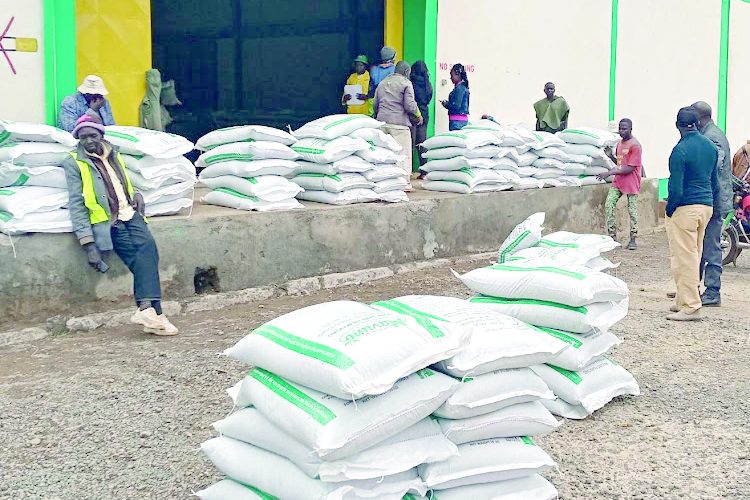
According to the report, one of the biggest risks stems from the Gulf region’s dominant role in global fertiliser production. Gulf states currently supply 45 per cent of the world’s sulphur and 50 per cent of global urea, both critical ingredients used in agricultural fertilisers.
“The reduction in supply hits as Q2 2026 planting begins across South Asia and East Africa, so the harvest shortfall will hit in late 2026 and early 2027,” the report states.
For Kenya, where agriculture contributes significantly to GDP and supports millions of livelihoods, any disruption in fertiliser supplies could translate into lower crop yields, reduced food production and higher consumer prices.
The warning is particularly significant given that East Africa has already been battling the effects of climate shocks, rising import costs and currency pressures over the past several years.
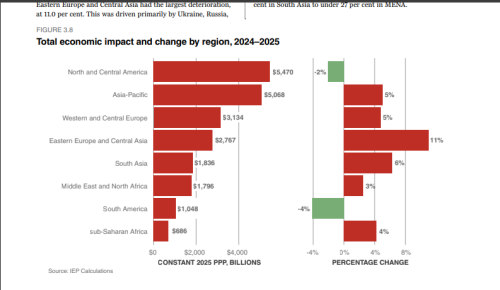
The report estimates that the global economic impact of violence reached an unprecedented Ksh3.5 quadrillion in 2025, equivalent to 10.5 per cent of global GDP. Military spending alone accounted for Ksh1.57 quadrillion, reflecting what the report describes as an increasingly fragmented and unstable geopolitical environment.
Inflation fears
IEP researchers argue that conflicts are no longer isolated events but are becoming interconnected regional shocks capable of affecting countries far beyond the battlefield.
In its analysis, the report highlights the growing strategic importance of the Red Sea and East Africa as global trade routes come under increasing pressure from regional instability.
“The Iran war is a force multiplier for the spread of conflict,” the report says.
“It has amplified existing pathways by raising prices in import-dependent states, distracting Gulf countries who are supporting conflict, and highlighting the strategic importance of Red Sea ports.”
For Kenya, whose economy relies heavily on imports of fuel, fertiliser and industrial inputs, disruptions in shipping lanes or commodity markets could have direct consequences for businesses and households.
The report’s findings come at a time when Kenya is attempting to stabilise public finances while sustaining economic growth.
It warns that any combination of higher food prices, increased fertiliser costs and debt refinancing challenges could place additional strain on government budgets and household incomes.
Beyond Kenya, the report paints a worrying picture for the wider East African region, arguing that geopolitical tensions in the Middle East and the Horn of Africa are becoming increasingly interconnected.
“The Horn of Africa is no longer a set of separate conflicts. The conflicts in Sudan, Ethiopia, Eritrea, South Sudan and Somalia are now interlocked through every channel that causes conflicts to spread,” the report reads.
As global conflicts become more interconnected, the report suggests that countries such as Kenya may find themselves increasingly exposed to economic shocks originating thousands of kilometres away.
For ordinary Kenyans, the consequences may ultimately be felt not on distant battlefields but at the farm gate, in food markets and through the rising cost of living.
Author
Latest News






Advertisement
More on Business