Advertisement
KeNHA reveals how much motorists will pay to use Nairobi–Nakuru–Mau Summit Road
Friday 24th October, 2025 06:38 PM|
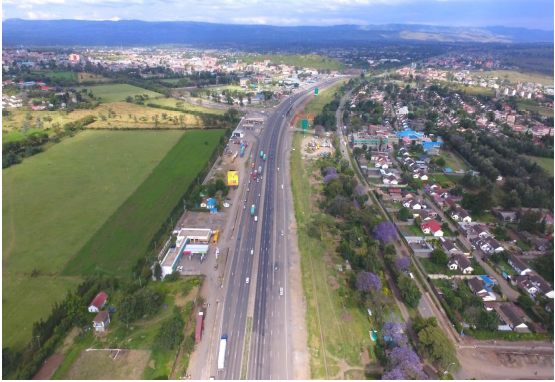
The Kenya National Highways Authority (KeNHA) has released a detailed report confirming that motorists using the Nairobi–Nakuru–Mau Summit Road will pay a toll rate of Ksh8 per kilometre, with an annual escalation rate of 1 per cent, once the project is completed.
According to the report published on KeNHA’s official website on October 22, 2025, the proposed tolling model emerged from the evaluation of a Privately Initiated Proposal (PIP) submitted by China Road and Bridge Corporation (CRBC) in partnership with the National Social Security Fund (NSSF).
“Based on comparative assessment, the Evaluation Committee concluded that China Road & Bridge Corporation (CRBC) & National Social Security Fund Trustees (NSSF) aligns with the Summary Brief Report for Project Development Phase documents of Privately Initiated Proposals for Design, Build, Finance, Operate, Maintain and Transfer of Nairobi – Nakuru – Mau Summit(A8) and Nairobi-Mai Mahiu-Naivasha (A8 South) Roads Contracting Authority’s Output Specifications and PPP Act Cap 430 requirements with a proposed toll rate of KShs. 8 per Km with a 1 per cent escalation rate per annum,” the statement reads.
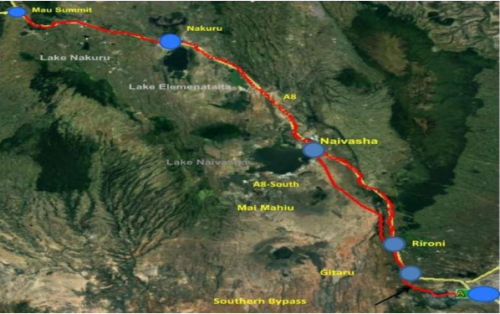
The report states that the project includes approximately 175 kilometres of the A8 Road and 58 kilometres of the A8 South section. “The project, comprising approximately 175 Km of the A8 Road and 58 Km of the A8 and A8 South Road respectively, is a strategic component of the Northern Corridor and the Trans-African Highway,” the statement reads.
Boosting regional connectivity
You Might Also Like

It is described as a strategic component of the Northern Corridor and the Trans-African Highway, a network crucial for boosting regional connectivity, trade facilitation, and economic integration across East and Central Africa.
“It is critical for regional connectivity, economic integration, and trade facilitation across East and Central Africa. The existing corridor suffers severe congestion and safety challenges due to high traffic volumes, necessitating capacity expansion, safety enhancements, and operational efficiencies,” the statement reads
KeNHA notes that the evaluation committee found the tolling models proposed by CRBC and NSSF on September 15, 2025, to be within acceptable ranges, though it acknowledged that affordability for end-users and fiscal support measures require further refinement during negotiations.
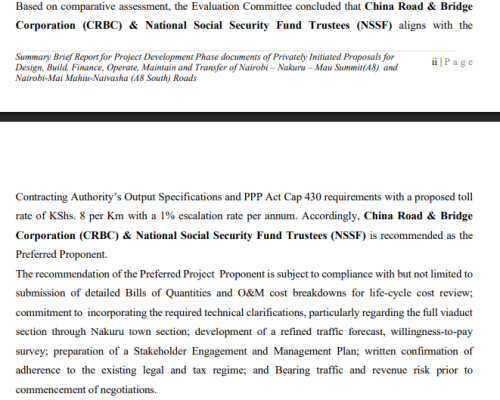
The committee further concluded that the CRBC–NSSF proposal aligns with the Contracting Authority’s Output Specifications and meets the requirements of the Public Private Partnership (PPP) Act, Cap 430. The report identifies the two entities as the preferred proponents for the multibillion-shilling infrastructure project.
The tolling system, once operational, is expected to help fund the maintenance and management of the high-traffic highway, one of the busiest in Kenya. The road links the capital to the Rift Valley and Western Kenya regions and serves as a major gateway for regional trade routes extending into Uganda, Rwanda, and the Democratic Republic of Congo.
KeNHA describes the project as critical for regional connectivity, economic integration, and trade facilitation across East and Central Africa, signalling its importance not only to Kenya’s infrastructure network but also to the broader region’s growth.
The report concludes that with a toll rate of Ksh8 per kilometre, the project remains economically viable while balancing investor returns and public affordability, pending final negotiations.
Author
Latest News





Advertisement
More on Business