Youth coalition warns Finance Bill 2026 could increase cost of digital health rollout
By Faith Lagat, May 26, 2026A youth-led civil society coalition has urged Parliament’s Departmental Committee on Finance and National Planning to exempt key digital health tools from proposed taxation measures in the Finance Bill 2026.
The appeal, coordinated by the Kenya Legal and Ethical Issues Network on HIV and AIDS (KELIN) under Transform Health Kenya, focuses on protecting Kenya’s expanding digital health ecosystem from increased costs that could slow implementation.
The coalition noted that Kenya is still developing its digital health infrastructure, with financing described as fragmented and unstable. It warned that higher taxes on software, platforms, devices, connectivity, and data systems could affect healthcare delivery across counties.
“We are concerned that some proposals in the Finance Bill, 2026 may increase the cost of digital health rollout, particularly in relation to software, digital platforms, devices, connectivity, electronic compliance systems, and health data infrastructure,” said Allan Maleche, Executive Director of KELIN, on May 26, 2026.
Proposed tax changes
A key concern raised by the group is the proposal to classify software-related payments as royalties under the Income Tax Act. The coalition said this could increase costs for systems such as Electronic Medical Records (EMR), Health Management Information Systems (HMIS), cloud-based platforms, health information exchanges (HIE), and software maintenance services.
The coalition also opposed proposed VAT, excise duties, and import levies on mobile phones and wireless network equipment, which are widely used by community health workers and public health facilities.
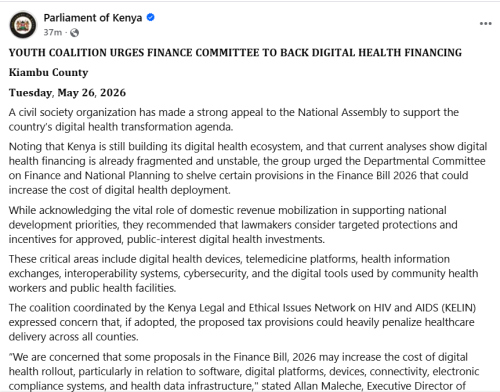
It recommended exemptions and incentives for approved public-interest digital health investments, including telemedicine platforms, cybersecurity systems, and interoperability tools used within the health sector.
In addition, the group raised concerns over potential tax data-reporting requirements, warning that they could compromise medical confidentiality. It emphasised that health data, including patient records, clinical information, and biometric data, is protected under Kenya’s data protection framework and should only be accessed under strict legal safeguards.
Parliamentary response
Committee Chairperson Kuria Kimani acknowledged the concerns raised, noting that while the proposals had merit, implementation could be complex due to the multi-use nature of some digital systems.
“How do you differentiate between a system used for healthcare purposes and one that has multiple usage?” he posed. He, however, pledged that the committee would examine the proposals with a view to supporting the health sector.
Committee members David Mboni and Peter Kaluma commended the youth coalition for participating in governance discussions. The engagement comes as Parliament also considers related reforms in the health sector, including the Traditional and Alternative Medicine Practitioners Bill 2026, which seeks to formalise indigenous healthcare practices.
At the same time, regional and global reports have highlighted Kenya’s role in addressing counterfeit medical products, reinforcing the need for strong digital systems to support regulation, traceability, and healthcare delivery.