Advertisement
Willis Otieno warns Finance Bill 2026 dividend proposal could hurt business growth
Thursday 21st May, 2026 07:35 AM|

Safina Party deputy party leader and lawyer Willis Otieno has criticised the decision by the government to propose a dividend tax in the Finance Bill 2026, arguing that it will negatively affect investment and business growth.
Taking it to his X handle on Thursday, May 21, 2026, Willis Otieno has voiced his concerns about the proposed changes to Section 24 of the Income Tax Act in the Finance Bill 2026, stating they may have a negative effect on investment, corporate governance, and economic growth in Kenya.
“The proposed amendment to Section 24 of the Income Tax Act under the Finance Bill 2026 raises serious macroeconomic and corporate governance concerns,” Otieno stated.
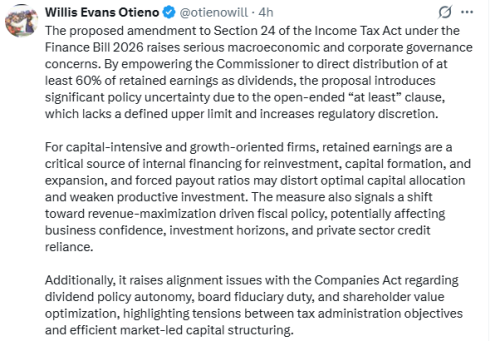
Otieno has said that the amendment, which will allow the commissioner to mandatorily remit at least 60 per cent of the companies’ retained earnings as dividends, creates significant uncertainty in the tax and investment policy environment in the country.
You Might Also Like



“By empowering the Commissioner to direct distribution of at least 60% of retained earnings as dividends, the proposal introduces significant policy uncertainty due to the open-ended ‘at least’ clause, which lacks a defined upper limit and increases regulatory discretion,” Otieno added.
Effect on businesses
The outspoken lawyer has said that the proposed law does not define the maximum amount of the payout requirement, which gives the regulators too much room to interpret the law. He added that the term “at least” is open-ended. He said that this uncertainty may leave businesses vulnerable to any tax administration decisions and lead to reduced investor confidence.
He also stated that retained earnings are important to capital-intensive companies and growth companies as an internal source of capital to finance business expansion, reinvestment, and capital formation. He cautioned that high payouts would have negative consequences on business planning and reduce investments that could be productive.

He warned that the amendment might impact long-term investment planning and lead to greater reliance on external borrowing and private credit.
The lawyer also commented on the compatibility between the proposal and the Companies Act, stating that the proposal may run counter to the autonomy of dividend policy traditionally enjoyed by the company’s boards and shareholders. He said that while the amendment would establish a focus on protecting shareholder value and sustainable business growth, it could result in conflicts between the goals of tax administration and efficient market-oriented capital structuring that is capital-market driven.
Otieno further noted that the government has a duty to improve tax collection, but policy should not compromise on the competitiveness of the private sector and discourage long-term investments.
Author
Latest News








Advertisement
More on News