Advertisement
Willis Otieno answers Duale: If public views don’t matter, why seek approval?
Thursday 04th June, 2026 06:15 AM|

Lawyer Willis Otieno has questioned the government’s communication approach in the ongoing debate surrounding Ebola preparedness, arguing that leaders cannot dismiss public input while simultaneously seeking public support and justification online.
Speaking in a statement shared on his X account on Wednesday, June 4, 2026, he appeared to fault what he termed as contradictory messaging from government officials amid growing public debate on Ebola response measures and quarantine concerns.
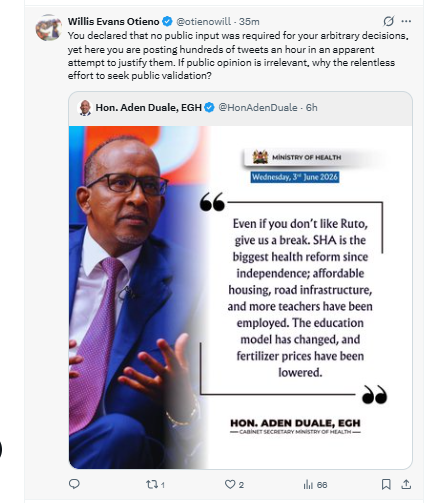
His remarks come after Health Cabinet Secretary Aden Duale ruled out public participation in matters relating to Ebola response measures, saying the Public Health Act does not require consultation during epidemic management.
Is public opinion irrelevant?
Otieno questioned why there appeared to be intense efforts to explain government decisions if citizens’ views were considered unnecessary in the first place.
You Might Also Like



“You declared that no public input was required for your arbitrary decisions, yet here you are posting hundreds of tweets an hour in an apparent attempt to justify them,” Otieno stated.
He added: “If public opinion is irrelevant, why the relentless effort to seek public validation?”
His remarks have added another layer to the debate on whether public trust should play a role in public health decisions even during emergencies.
Duale rules out public participation
Appearing before the National Assembly on Wednesday, Duale defended the government’s position, insisting that disease outbreaks require immediate action rather than prolonged consultation.
“Under the Public Health Act, we don’t need to do public participation. We are not going to consult citizens,” Duale said.
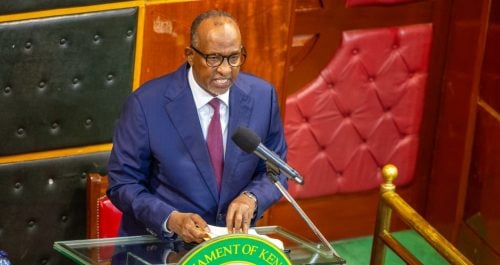
The Health CS argued that delaying intervention during disease outbreaks could expose Kenyans to greater risks.
“This epidemic does not require any consultation. Tomorrow, God forbid, if Ebola is found in this country, this House will call me back here to ask me why Kenyans are dying,” he added.
Debate shifts to public trust
The exchange has now widened discussion beyond Ebola preparedness itself and into broader questions of public trust, accountability and communication.
While Public Health Principal Secretary Mary Muthoni has maintained that Kenya remains Ebola-free and all 25 tested suspected cases have returned negative results, debate continues over whether emergency action and public confidence can operate separately.
As scrutiny grows, questions are increasingly shifting from legal requirements to whether public trust can be built without public involvement.
Author
Latest News



Advertisement
More on News