Willis Otieno: Africa must rely on own solutions to strengthen Ebola response systems
By Sharon Atieno, June 5, 2026Lawyer Willis Otieno has called for a stronger shift toward African-led solutions in addressing health emergencies, arguing that long-term resilience against outbreaks such as Ebola must be rooted in domestic and regional capacity rather than overreliance on external arrangements.
In a statement shared on his X account on Friday, June 05, 2026, Otieno emphasized that Africa’s public health future depends on building strong internal systems capable of preventing, detecting, and responding to outbreaks without depending primarily on foreign-designed frameworks.
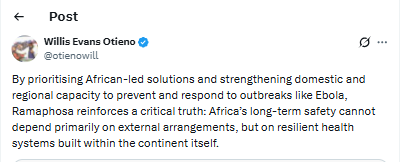
By prioritising African-led solutions and strengthening domestic and regional capacity to prevent and respond to outbreaks like Ebola, Otieno said, Africa must reinforce the reality that sustainable health security cannot be outsourced.
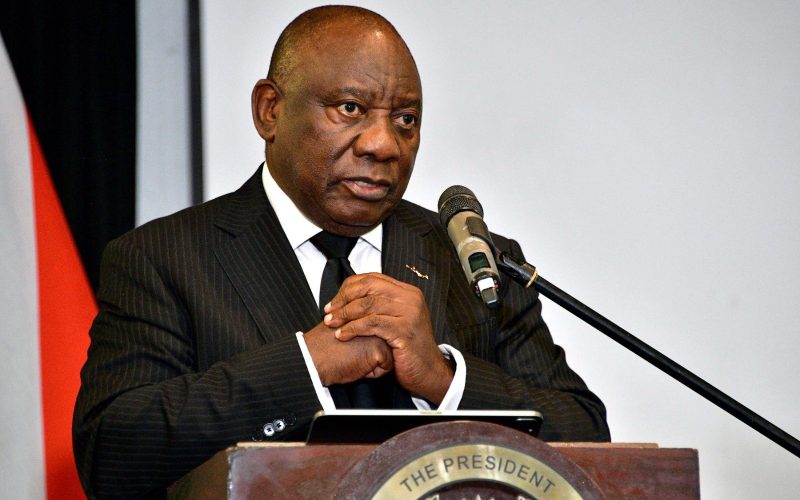
“By prioritising African-led solutions and strengthening domestic and regional capacity to prevent and respond to outbreaks like Ebola, Ramaphosa reinforces a critical truth: Africa’s long-term safety cannot depend primarily on external arrangements, but on resilient health systems built within the continent itself,” he said.
Foreign influence debate
Otieno also raised concern over what he termed a growing tendency to frame key national decisions within foreign-driven narratives, warning that such approaches risk weakening domestic accountability structures.
“We are increasingly normalising a dangerous pattern where external partnerships and foreign interests are invoked in ways that blur, or outright override, our own constitutional processes,” he said.
He questioned whether foreign leaders would realistically have detailed knowledge of Kenya’s internal infrastructure to influence specific operational decisions, arguing that such framing risks distorting public understanding of policy-making.
“Are we really expected to believe that a foreign head of state, such as President Trump, has detailed awareness of Kenya’s internal military infrastructure, down to specific sites like Laikipia Air Base, and would be precise enough to dictate its use for a quarantine facility?” he posed.
Call for accountability
According to Otieno, the core issue is not international cooperation, but how government decisions are communicated and justified to citizens.
“The real issue here is not foreign knowledge or influence; it is the domestic tendency to frame critical policy choices as externally driven, thereby weakening accountability at home,” he stated.
Sovereignty and governance debate
His remarks echo similar sentiments raised by Democratic National Alliance Secretary General Barrack Muluka, who has insisted that Kenya’s sovereignty is rooted in the people and must guide all national decisions, including sensitive public health measures.
As debate intensifies over the proposed Ebola preparedness facility, leaders and legal experts continue to question the balance between international cooperation and domestic accountability, with growing calls for transparency in how such agreements are framed and implemented.