WHO raises alert levels as Ebola outbreak spreads in Central Africa
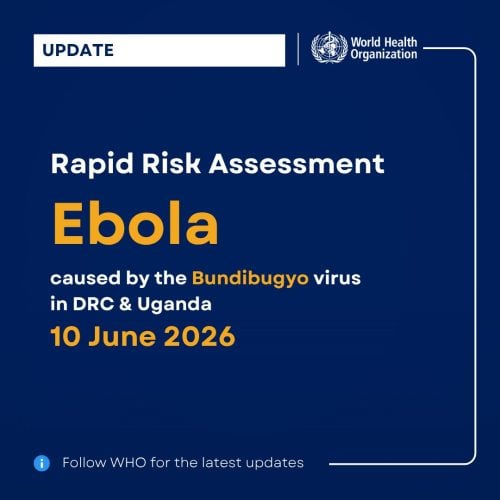
By Martin Oduor, June 10, 2026The World Health Organization (WHO) on Wednesday, June 10, 2026, issued a stark warning regarding the rapidly expanding Ebola outbreak in Central Africa, escalating its threat assessments as containment efforts struggle against a toxic combination of armed conflict, community resistance, and untraced transmission lines.
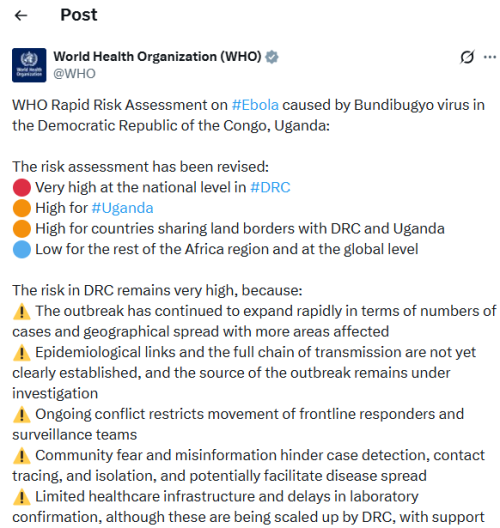
In a newly published Rapid Risk Assessment, global health officials elevated the national risk level for the Democratic Republic of Congo to “very high”.
The alert level for neighbouring Uganda was raised to “high,” reflecting a sharp increase in anxiety over cross-border spillover.
Furthermore, the agency designated the risk for all countries sharing land borders with either the Congo or Uganda as “high,” signalling that the outbreak is quickly evolving from a localised crisis into a major regional emergency.
While the threat to the rest of the African continent and the global level remains officially classified as “low,” the internal dynamics of the outbreak have ignited alarms among epidemiologists in Geneva.
The current emergency is driven by the Bundibugyo virus, a less common variant of the Ebola virus.
Unlike the more frequent Zaire strain, for which effective vaccines and treatments exist, the Bundibugyo strain presents unique operational hurdles for frontline health workers.
According to the WHO, the situation inside the Democratic Republic of Congo has deteriorated because the virus has continued to expand rapidly in terms of raw patient numbers and geographic spread, penetrating previously unaffected territories.
More troubling still is that health workers are operating in the dark: epidemiological links and the full chain of transmission are not yet clearly established. The original source of the outbreak remains a subject of ongoing investigation.
“The outbreak has continued to expand rapidly in terms of numbers of cases and geographical spread with more areas affected.”
WHO emphasised that the Congolese government is actively attempting to scale up its response with the support of international partners.
However, these efforts are being systematically undermined by structural delays in laboratory confirmations and a severely strained domestic healthcare infrastructure, leaving clinicians trailing behind the pathogen’s actual trajectory.
The geography of risk
Democratic Republic of Congo: Elevated to Very High due to rapid geographic expansion and unmapped transmission chains.
Uganda: Designated as High risk amid increased threat of immediate cross-border spillover.
Bordering Nations: Rated High for all countries sharing direct land boundaries with the Congo or Uganda.
Global & Continental: Assessed as Low for the rest of the African region and international communities.
The clinical challenges of the Bundibugyo outbreak are profoundly amplified by the reality on the ground in eastern Congo.
WHO noted that ongoing conflict in the affected provinces has severely restricted the physical movement of frontline responders and medical surveillance teams, creating vast blind spots where the virus can spread unchecked.