Advertisement
Wetang’ula defends cybercrime law amid censorship claims
Sunday 26th October, 2025 04:40 PM|

National Assembly Speaker Moses Wetang’ula has robustly defended the recently assented Computer Misuse and Cybercrimes (Amendment) Act, 2025, describing it as a vital shield for Kenyan families rather than a tool for censorship.
Speaking on Sunday, October 26, 2025, at St. Teresa’s Isanjiro Catholic Church in Malava Town, Kakamega County, Wetang’ula sought to clarify the law’s intent amid growing public debate.
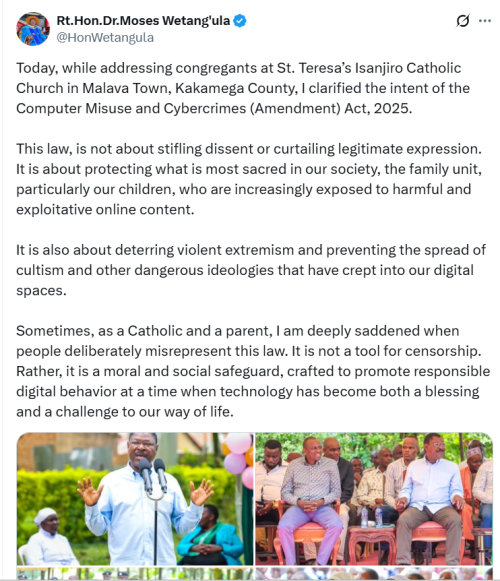
“Today, while addressing congregants at St. Teresa’s Isanjiro Catholic Church in Malava Town, Kakamega County, I clarified the intent of the Computer Misuse and Cybercrimes (Amendment) Act, 2025,” he stated, emphasising its protective purpose.
This comes after the government spokesperson assured Kenyans that the cybercrime law does not infringe on freedom of speech.
Safeguarding family values and digital morality
You Might Also Like



Wetang’ula stressed that the legislation aims to preserve societal values, particularly the safety of children. “This law is not about stifling dissent or curtailing legitimate expression. It is about protecting what is most sacred in our society, the family unit, particularly our children, who are increasingly exposed to harmful and exploitative online content,” he explained.
He added that the law also carries national security implications. “It is also about deterring violent extremism and preventing the spread of cultism and other dangerous ideologies that have crept into our digital spaces.”
Expressing personal concern as both a Catholic and a parent, Wetang’ula addressed misconceptions surrounding the Act. “Sometimes, as a Catholic and a parent, I am deeply saddened when people deliberately misrepresent this law. It is not a tool for censorship. Rather, it is a moral and social safeguard, crafted to promote responsible digital behaviour at a time when technology has become both a blessing and a challenge to our way of life,” he said via an X post dated October 26, 2025.
Also watch: Embu Catholic Church Backs Cybercrime Act, Citing Moral Responsibility
Government clarifies law’s intent
On Thursday, October 23, 2025, Government Spokesperson Isaac Mwaura issued a press statement asserting that the Act strengthens Kenya’s ability to tackle cybercrime while respecting constitutional freedoms. According to Mwaura, the amendments address real threats such as child pornography, online extremism, terrorism propaganda, cyber harassment, identity theft, and financial fraud.
He clarified that the National Computer Cybercrimes Coordination Committee’s power to block websites requires proof of unlawful activity and is subject to judicial review under Articles 47 and 50 of the Constitution. “The freedoms of expression and media under Articles 33 and 34 remain intact,” Mwaura said, “subject only to limitations prescribed by law in the interest of national security, public safety and morality.”
Support and legal challenge
The Act’s passage on October 15, 2025, alongside other bills such as the Wildlife Conservation and Management (Amendment) Act and the Virtual Asset Service Providers Act, reflects a comprehensive legislative push. However, a Nairobi High Court on October 22, 2025, issued a conservatory order suspending enforcement of key sections—27(1)(b), (c), and (2)—pending a petition by musician Reuben Kigame and the Kenya Human Rights Commission (KHRC). The petitioners argue the law conflicts with the Data Protection Act and undermines constitutional freedoms, with a hearing scheduled for November 5, 2025.
Busia Senator Okiya Omtatah criticised the Act’s vagueness, suggesting it was hurriedly drafted. “The new Computer Misuse and Cybercrimes (Amendment) Act, 2024, introduces vague concepts that can be abused to curtail freedoms. The bill was poorly drafted. If I were to fault it, I would fault it on the issue of vagueness,” he said.
He questioned provisions like “inappropriate sexual content of a minor,” asking, “Is there any appropriate sexual content of a minor? There is none! What is it trying to justify?”
Support for the law came from Embu Catholic Bishop Peter Kimani, who endorsed it on October 25, 2025. “The social media trends that we are seeing, we have to be controlled through social media. The Cybercrime Act lazima ikuwe controlled. We see all manner of evils that happen,” he said.
Nandi Senator Samson Cherargei and Dagoretti South MP John Kiarie also backed the law, highlighting its role in combating cyberbullying, online exploitation, and fraud. Kirinyaga Woman Representative Njeri Maina, however, raised concerns about potential misuse to silence dissent—a view countered by Mwaura’s reassurance of judicial oversight.
Author
Latest News






Advertisement
More on News