Advertisement
Wandayi says G-to-G fuel was Ksh43.4 per litre cheaper
Sunday 05th April, 2026 03:38 PM|

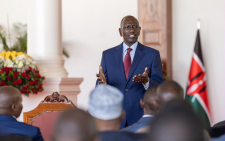
Energy Cabinet Secretary Opiyo Wandayi has moved to steady nerves in Kenya’s petroleum sector, insisting the government-to-government (G-to-G) fuel deal is saving the country money despite a widening scandal that has forced senior officials out of office.
In a statement on Sunday, April 5, 2026, Wandayi said the G-to-G framework delivered petrol at a significantly lower cost than a recent emergency shipment now under investigation.
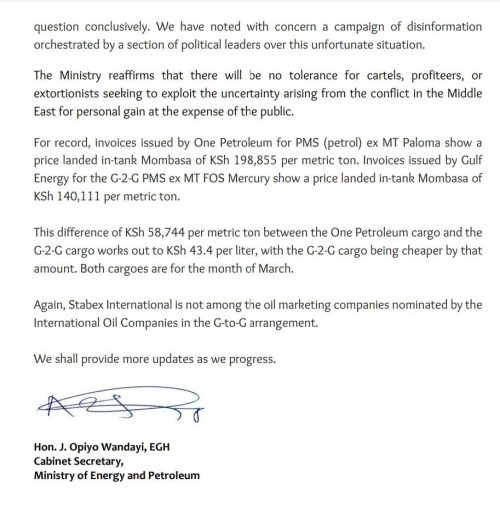
“For record, invoices issued by One Petroleum for PMS ex MT Paloma show a price landed in-tank Mombasa of Ksh198,855 per metric ton,” he said. “By comparison, invoices from Gulf Energy for the G-to-G PMS ex MT FOS Mercury show a landed price of Ksh140,111 per metric ton.”
He added:
You Might Also Like



“This difference of Ksh58,744 per metric ton between the One Petroleum cargo and the G-to-G cargo works out to Ksh43.4 per litre, with the G-to-G cargo being cheaper by that amount.”
Wandayi used the figures to defend the G-to-G system, which Kenya introduced in 2023 to secure fuel supply and stabilise prices after a period of shortages. He said the arrangement “remains stable and resilient” and continues to shield consumers from global price shocks, especially amid tensions in the Gulf.
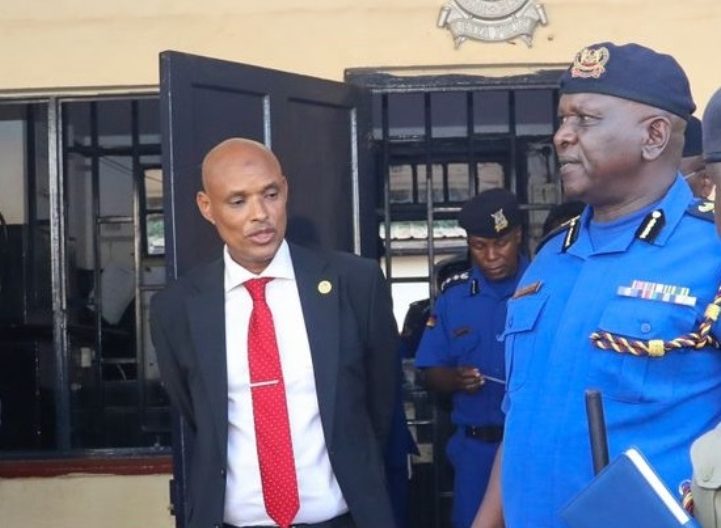
His remarks come at a tense moment for the sector. Several top officials, including Petroleum Principal Secretary Mohamed Liban, Kenya Pipeline Company Managing Director Joe Sang, and Energy and Petroleum Regulatory Authority Director General Daniel Kiptoo, have resigned following arrests and investigations into claimed irregularities in fuel imports.
Authorities suspect some officials manipulated fuel stock data to create the impression of a shortage. Investigators believe this may have paved the way for an emergency fuel purchase outside the G-to-G framework.
The shipment in question, carried aboard MT Paloma, reportedly arrived in Mombasa in late March. Early findings suggest it cost more than standard G-to-G cargo and may not have met quality standards.
Government moves to reassure
Wandayi confirmed that the government has already taken action to prevent further risk.
“When full information about the fuel shipment that is the subject of investigations emerged, we stopped the delivery of a second cargo under similar circumstances, thus protecting and securing public interest,” he said.
He also assured the public that fuel stocks remain sufficient.
“We further wish to reassure the public that there are sufficient stocks of petroleum products to meet current demand,” he said, adding that the government will maintain “an uninterrupted supply of quality fuel”.
At the same time, the ministry has launched a full internal review of petroleum management systems. The exercise will focus on improving transparency, strengthening oversight and protecting the integrity of the supply chain.
Wandayi urged the public to allow investigators to complete their work without interference.
“We wish to appeal to the public to be patient and allow the relevant government agencies to undertake independent and professional investigations into the matters in question conclusively,” the statement read.
He also pushed back against what he described as misinformation from political actors. He warned that the government will act firmly against those seeking to exploit the situation.
“The government will show zero tolerance for cartels, profiteers or extortionists who try to exploit uncertainty… for personal gain,” he said.
Wandayi addressed claims linked to companies involved in the fuel trade:
“Stabex International is not among the oil marketing companies nominated by the International Oil Companies in the G-to-G arrangement”.
Gachagua defends fuel officials
The political row around the scandal has also intensified. Former Deputy President Rigathi Gachagua has defended the officials under investigation, claiming they acted in the public interest by sourcing cheaper fuel outside the G-to-G framework.
“The accusation is that they have brought in substandard fuel. That is not true. I want to tell the people of Kenya the truth,” Gachagua said. He argued that the arrests were driven by competition with the G-to-G system, which he claimed benefits a few connected players.
Gachagua went further, claiming that the officials targeted by investigators were trying to cushion Kenyans from rising fuel costs.
“They decided to get cheaper fuel so that they can help cushion the people of Kenya from price hikes,” he said, adding that their actions created friction with existing supply arrangements.
Author
Kenneth Mwenda
Kenneth Mwenda is a business, sports, and politics digital writer with over seven years of experience in journalism, covering breaking news, feature stories, and in-depth analysis across a range of beats.
For inquiries, he can be reached at [email protected]
View all posts by Kenneth MwendaLatest News






Advertisement
More on News