Wamuchomba calls for EPZ status for tea and coffee factories amid rising levies
By Cy Muganda, December 22, 2025Githunguri MP Gathoni Wamuchomba has called for tea and coffee processing facilities to be granted Export Processing Zone status, arguing that mounting government levies and high electricity costs are forcing primary production units to shut down.
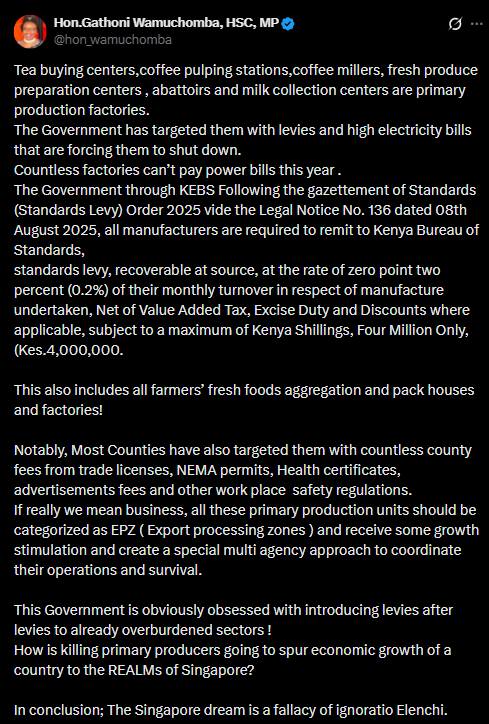
In a statement posted on her X account on Monday, December 22, 2025, Wamuchomba warned that the government’s approach to taxing agricultural processing facilities threatens Kenya’s primary production sector and contradicts stated economic growth ambitions.
The MP listed tea buying centres, coffee pulping stations, coffee millers, fresh produce preparation centres, abattoirs and milk collection centres as primary production factories being targeted with multiple levies.
“The Government has targeted them with levies and high electricity bills that are forcing them to shut down. Countless factories can’t pay power bills this year,” Wamuchomba stated.
Standards levy burden
According to the MP, the gazettement of the Standards (Standards Levy) Order 2025 via Legal Notice No. 136 dated August 8, 2025, by the Kenya Bureau of Standards (KEBS) has introduced a new financial burden on manufacturers.
Under the new regulations, all manufacturers are required to remit a standards levy of 0.2% of their monthly turnover to KEBS, calculated net of Value Added Tax, Excise Duty and discounts where applicable, subject to a maximum of Ksh4 million.
“This also includes all farmers’ fresh foods aggregation and pack houses and factories!” Wamuchomba noted, highlighting the extensive reach of the levy.
County-level fees
The Githunguri legislator further faulted county governments for what she described as excessive charges, saying most counties have imposed countless county fees from trade licenses, NEMA permits, Health certificates, advertisement fees and other workplace safety regulations.
According to Wamuchomba, the cumulative effect of national and county levies has left many factories unable to operate sustainably.
“Most Counties have also targeted them with countless county fees from trade licenses, NEMA permits, Health certificates, advertisement fees and other workplace safety regulations,” she said.
EPZ proposal
Calling for policy reform, the MP argued that designating primary production units as EPZs would allow them to receive growth stimulation and benefit from a coordinated, multi-agency support framework.
“If really we mean business, all these primary production units should be categorised as EPZ (Export processing zones) and receive some growth stimulation and create a special multi-agency approach to coordinate their operations and survival,” Wamuchomba stated, criticising what she described as the government’s obsession with introducing levies on already overburdened sectors.
Economic growth concerns
Wamuchomba questioned how the government’s taxation approach aligns with Ruto’s stated ambition of transforming Kenya into an economy comparable to Singapore.
“How is killing primary producers going to spur economic growth of a country to the REALMs of Singapore?” she asked.
“In conclusion, the Singapore dream is a fallacy of ignoratio Elenchi,” she added.