Advertisement
UDA and ODM lead as Kenya’s most popular political parties – TIFA
Wednesday 24th September, 2025 12:37 PM|
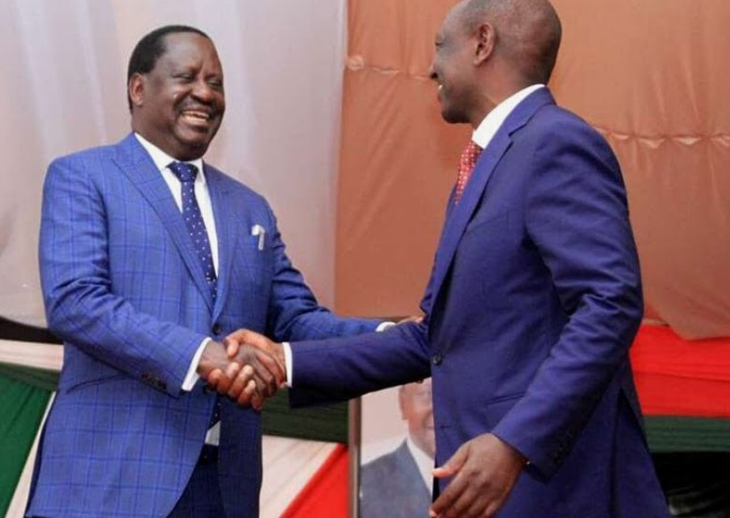
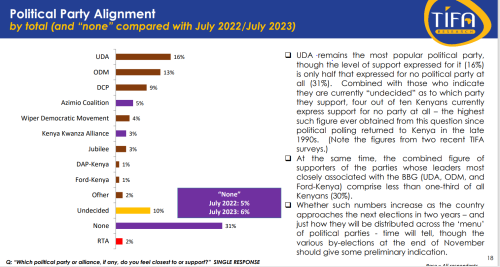
The ruling United Democratic Alliance (UDA) party has been polled as the most famous party in Kenya, according to a survey conducted by TIFA and released on Wednesday, September 24, 2025.
The William Ruto-led outfit garnered 16 per cent support; however, a majority of Kenyans (31%) expressed no preference for any political party.
Raila Odinga’s Orange Democratic Movement (ODM) is second with a preference rating of 13 per cent.
DCP ranked third
The ranking comes as the Orange party looks to mark its 20th anniversary celebrations, a milestone positioning it among the oldest political parties in the country.
You Might Also Like



Former Deputy President Rigathi Gachagua’s Democracy for Citizens Party (DCP) ranks third with an approval of nine per cent.
The party officially entered the Kenyan political fray on Thursday, May 15, 2025, coming after the former second in command moved to form his own political outfit following his disgraced exit from UDA through the 2024 impeachment.
Jubilee and the Kenya Kwanza Alliance enjoy a three per cent rating, with the Democracy Action Party of Kenya (DAP-K) and Ford Kenya coming in behind with a one per cent rating each among Kenyans.

Azimio Coalition, the losing coalition in the 2022 polls, comes in fourth on the parties’ preferences list with five per cent, just a percentage above the Wiper Democratic Movement of Kalonzo Musyoka that recently rebranded to the Wiper Patriotic Front (WPF).
Combined support
According to TIFA, the 31% who stated no preference for any political party, combined with those who indicated they are currently “undecided”, at 10%, implies that four out of ten Kenyans currently express support for no party at all – the highest such figure ever obtained from this question since political polling returned to Kenya in the late 1990s.
TIFA also revealed that the combined figure of supporters of the parties whose leaders are most closely associated with the broad-based government (UDA, ODM, and Ford-Kenya) comprises less than one-third of all Kenyans (30%).
They have, however, acknowledged that the number is subject to change with the elections beckoning in two years. The pollster observed that the various by-elections at the end of November are likely to give some preliminary indication of the new distributions.
Author
Latest News





Advertisement
More on News