TVET institutions under scrutiny as audit exposes ethnic bias in recruitment
By Emmanuel Rono, June 23, 2026The National Assembly’s Public Investments Committee on Education and Governance has raised alarm over widespread violations of ethnic diversity laws in staffing at several Technical and Vocational Education and Training (TVET) institutions, warning that the trend undermines national cohesion and constitutional principles.
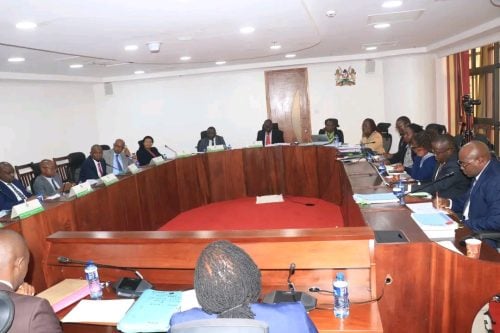
The committee, chaired by Luanda Member of Parliament Dick Maungu, was sitting at Bunge Towers, Parliament Buildings, on Tuesday, June 23, 2026, to examine Auditor-General reports covering the 2018/2019 to 2024/2025 financial years for various public institutions when the issue emerged.
Institutions that appeared before the committee included Bungoma North Technical and Vocational College, Chamasiri Technical and Vocational College, Musakasa Technical Training Institute, and Okame Technical and Vocational College.
Inside the audit findings
Audit findings tabled before MPs revealed repeated breaches of the National Cohesion and Integration Act, 2008, which requires that no public institution should have more than one-third of its staff from a single ethnic community.
At Bungoma North Technical and Vocational College, the Auditor-General established that out of 76 employees, 57 representing 75 per cent were from one dominant ethnic community.
The college principal, Lilian Simali, admitted the imbalance but attributed it to the institution’s early staffing process.
“Management acknowledges the audit finding and wishes to clarify that the imbalance arose during the initial staffing phase when recruitment relied on locally available personnel,” Simali stated.
She added that the institution was now encouraging qualified applicants from across the country to apply for vacancies in a bid to enhance diversity and regional balance.
At Chamasiri Technical and Vocational College, auditors established that 32 out of 73 staff members, representing 44 per cent, were drawn from one ethnic community in the 2024/2025 financial year.
Another audit review further showed that 45 out of 77 staff members, equivalent to 58 per cent, were from the same community during an earlier review period. College Principal Lawrence Ongata told MPs that the staffing patterns were historical.
“The current staff composition reflects historical recruitment patterns. Management is committed to ensuring compliance with the law in future recruitments,” Ongata said.
Mps warnings
Maungu warned that public institutions must uphold constitutional values and ensure fair representation in employment.
“Public institutions are funded by taxpayers from every corner of this country and therefore recruitment must reflect the face of Kenya. Ethnic imbalance in public service is not only unlawful but also undermines national unity and fairness,” he said.
He added that the committee would not accept continued reliance on historical recruitment patterns as justification for exclusion.
“We cannot continue normalising historical recruitment patterns as an excuse for exclusion. Institutions must develop deliberate policies to ensure future recruitment processes comply fully with the National Cohesion and Integration Act,” Maungu said.
The committee directed the institutions to submit compliance frameworks and recruitment plans outlining how they intend to achieve equitable ethnic representation going forward.