Advertisement
Sossion blames school fires on neglect, congestion and weak enforcement of safety rules
Tuesday 02nd June, 2026 08:18 AM|

Former Kenya National Union of Teachers (KNUT) Secretary General Wilson Sossion has attributed the recurring cases of school dormitory fires in Kenya to systemic neglect, overcrowding in learning institutions, and weak enforcement of existing safety regulations.
Speaking during an interview with a local TV station on Tuesday, June 2, 2026, Sossion reflected on a long history of fire tragedies in Kenyan schools spanning nearly three decades, including the Bombolulu Girls’ fire of 1998, the Kyanguli Secondary School tragedy, and a series of widespread incidents recorded between 2015 and 2018.
Sossion noted that school fires have persisted over time, with particularly intense outbreaks in the mid-2010s, when several boarding schools across the country experienced repeated nighttime dormitory fires.
He recalled that during that period, educators often described the situation as a “fire festival”, as incidents appeared to occur almost simultaneously in different institutions.
You Might Also Like



“If you look at the chronology of the occurrence (school fires), it has gone on for close to 30 years now. Remember the Bombolulu Girls fire in 1998? Then we had Kyanguli, and we have had this over repeated time across many schools, and it was very intensive between 2015, 2016, 2017, and 2018. Many schools were burning; in fact, teachers were calling it every evening a fire festival across schools because it used to occur at night, and students were burning dormitories,” Sossion said.
He further cited the 2024 Endarasha tragedy, where learners were reportedly locked inside a wooden dormitory, describing it as a criminal lapse in safety standards.
“We had the Endarasha fire the other day, in 2024, where students were locked up in a wooden dormitory; that was actually criminal, and now we have had this one (Utumishi Girls fire),” he said.
Utumishi Girls Academy fire
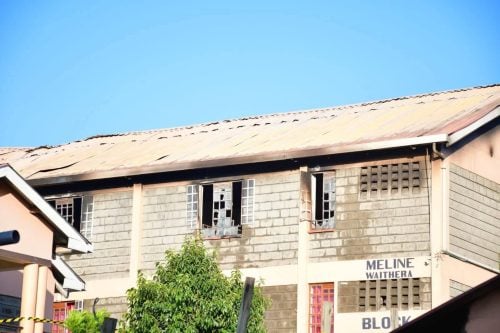
His remarks come in the wake of the recent Utumishi Girls Academy fire tragedy, which claimed 16 lives and left several others injured, reigniting national debate on boarding school safety, compliance, and enforcement of regulations.
Sossion questioned whether relevant authorities had conducted timely inspections and follow-ups in schools prior to such incidents.
“If we pick Utumishi Girls’ Academy, we will ask questions: When was the school last supervised? When did quality assurance inspect that dormitory, and what recommendations did they give?” he posed.
Blame on congestion and weak enforcement
Sossion argued that overcrowding in boarding schools remains a major contributing factor to fire tragedies, pointing out that many dormitories are stretched beyond their recommended capacity.
He said beds are often fitted in every available space, including corridors, a situation he attributed to the pressures of the government’s 100 per cent transition policy in education.
He further blamed weak enforcement of safety standards by both school administrators and oversight institutions, including the Ministry of Education and quality assurance agencies.
“Look at the congestion. The beds were fitted in every space, including the corridors. That speaks to the congestion that we have entertained over time because of the 100 per cent transition in our boarding schools. Basically, this is non-compliance with the regulations and standards by our institutions that are supposed to enforce them, ranging from the ministry to schools,” Sossion said in reference to CCTV footage that recently emerged showing what had transpired at Utumishi Girls’ Academy moments before the fire tragedy.

Call for strict implementation of existing regulations
The former KNUT leader insisted that Kenya does not need new policies but rather strict enforcement of existing school safety guidelines and regulations.
“Schools have got guidelines. What we are witnessing is blatant disregard of those guidelines and non-supervision by relevant institutions,” he said.
Sossion urged education authorities to ensure rigorous inspections, compliance audits, and accountability mechanisms in all boarding schools.
Sossion’s remarks add to growing national concern over school safety, as calls intensify for a comprehensive review of boarding school infrastructure, emergency preparedness systems, and compliance enforcement across the country.
As investigations into recent incidents continue, stakeholders in the education sector are under increasing pressure to prevent further tragedies and restore confidence in the safety of learning institutions across Kenya.
Author
Mustafa Juma
View all posts by Mustafa JumaLatest News








Advertisement
More on News