Advertisement
Ship with good tidings for Lamu and pastoralists
Monday 17th October, 2022 04:51 AM|
Docked serenely at the Port of Lamu, Togolese ship MV Banyas 1 is making history —at once buoying the fortunes of the town and those of livestock keepers in the drought-hit parts of Kenya.
For most of yesterday, the large vessel was being loaded with livestock destined for Port Salalah in the Middle East’s state of Oman. The voyage is scheduled to start tomorrow (Tuesday).
The shipment, according to the manager in charge of Lamu port operations, Peter Masinde, is a milestone — it will be the first local consignment from the new harbour, and will also help pastoralists off-load their drought-hit livestock.
Taking off smoothly
“The fact that livestock importers have decided to use this port is a testament to the good tidings ahead. Indeed, the port is taking off smoothly and attracting world class investments,” Masinde says.
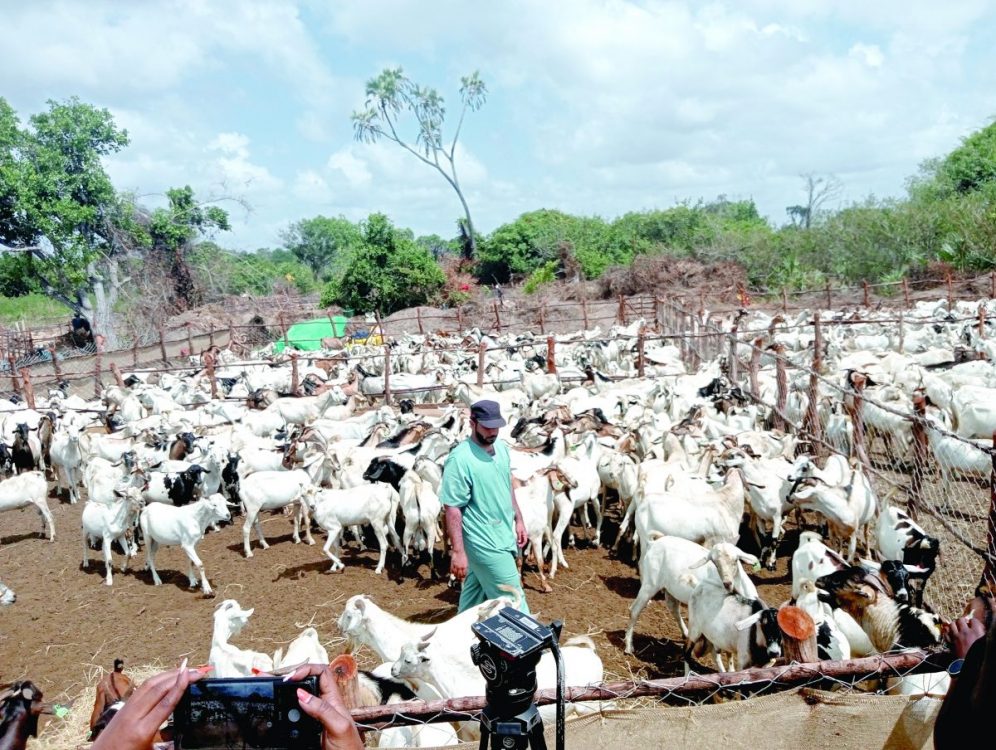
At Magogoni, 8km from the new port, about 200 bulls and a herd of 15,400 sheep and goats are at a holding area where a team of veterinary officers are keenly assessing their health, in accordance with the accepted international standards for animal exports.
All the animals are male, a factor which veterinarian Shibab Albulushi from the Sultanate of Oman says is deliberate to minimise chances of infection during the trip and also to encourage reproduction at the source market for future stock.
“The animals are mainly for slaughter in the Sultanate. Females are meant for reproduction and, therefore, it is wasteful to slaughter them. At the same time, females giving birth during such a trip could be a health risk to the other animals,” the vet explained at the holding area.
Next to the livestock is a towering pile of hay which will also be loaded onto the ship to sustain the livestock during the seven to nine days voyage, depending on conditions of the ocean.
The Sultanate of Oman’s Al Bashayer Meat Company bought the livestock from Kilifi, Tana River and Lamu counties.
This is the third time the company is importing live animals from Kenya, having previously done so from the port of Mombasa in January and February this year.
Monthly shipment
Al Bashayer’s International trade manager Jack Kisero says the company has leased MV Banyas for monthly shipment of livestock for the next one year, subject to review, depending on the vicissitudes of the nascent business.
“For this third shipment, we decided to use the port of Lamu because it is nearer to Salalah by 36 hours compared to Mombasa. Also, the port is far less busy, hence ideal for livestock shipment,” explained Kisero, adding that the company will be having a rotation every 30 days “until we see how best this port works for us”.
The manager is of the view that the port of Lamu is ideal for shipment of live animals because it is less congested.
“We believe Lamu is ideal for us because it is closer to Salalah by around 36 hours. So we will be saving a day and a half. And because the port is new, it’s not congested and, therefore, ideal for animal welfare. In our last shipment via the port of Mombasa, we realised there was congestion there. Also, according to animal welfare policy, livestock should not be on transit for long.
The issue of high and low tides also meant that the loading time in Mombasa was longer. We are not facing these issues here in Lamu,” he said in an interview at the deep-water island.
He also noted that the holding area for the port of Mombasa is 80km away, compared to just 8km in Lamu. This is a plus for animal welfare, he explained
Lamu’s proximity to the northern corridor, a key source market for targeted livestock such as black-head sheep and Gala goats, makes the port strategic for livestock shipment, according to Kisero.
“We have contracted suppliers who are getting animals from all the country but the reason we moved to Lamu is that it is closer to the source. Animals like gala goats and black-head sheep are in high demand in Oman. Traditionally, they were sourced from Garissa and other northern corridor counties. But we are also getting merino sheep from Narok and camel from Tana River,” the manager said.
The livestock export programme is likely to turn around the fortunes of pastoralist communities across the country, coming at a time when over one million livestock have died of drought.
According to Masinde, this is an opportunity for local communities to invest in quality production of livestock for export.
“We appeal to pastoralists to take advantage of the huge opportunity available in livestock rearing and farming of animal feeds. These are some of the opportunities to develop,” said the port official.
Masinde reckons that there has been continuous engagement of various government agencies with potential importers to prepare for live animal exports.
From these engagements, he said, three shipping lines have called at the port Lamu. Banyas 1 is the fourth.
“To handle livestock, you require three key facilities at the port. One is a holding area for fattening and laboratory services. This is where the animals are inspected to ensure they are in good health and ready for shipment, free of disease. The government plans to set up these facilities.
Dedicated 20 acres
“The existing lab facilities at the coast are in Mariakani, which is far away from the port of Lamu. A lab facility will be built in Witu and a livestock holding area at Bargoni. Within the port of Lamu, there will be a livestock holding area. To this end, the Kenya Ports Authority has dedicated 20 acres, besides berth number one where a livestock holding area will be set up.
“The Department of Livestock has committed to fund the facility. They have already allocated the money and are now looking for a contractor,” said Masinde.
Players in the livestock sector believe this first shipment from Lamu will encourage locals and other investors, hence opening up the economies of semi-arid areas in Kenya and East Africa.
Author
Reuben.Mwambingu
View all posts by Reuben.MwambinguLatest News








Advertisement
More on News