Advertisement
Salasya blames leadership failure as Nairobi flood crisis worsens
Sunday 08th March, 2026 06:21 PM|

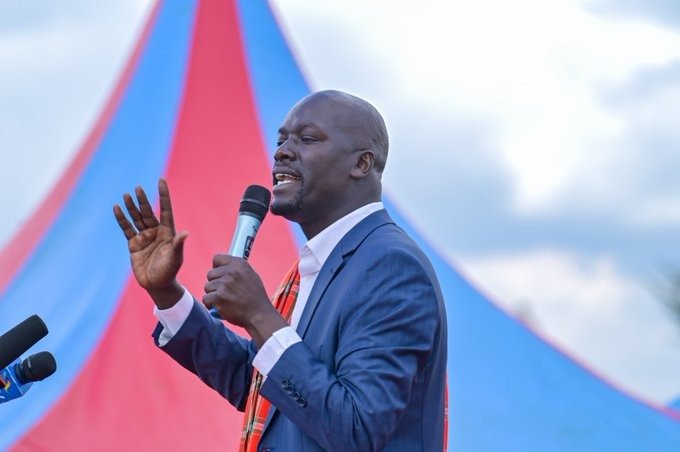
Mumias East Member of Parliament (MP) Peter Salasya has blamed leadership failure for the worsening flooding crisis in Nairobi, arguing that the city is drowning not only because of rain but also due to poor governance and broken development promises.
Taking to his official X account on Sunday, March 8, 2026, Salasya criticised the administration of President William Ruto, questioning the effectiveness of the Nairobi River regeneration programme launched in 2022.
The programme was intended to restore the polluted Nairobi River and its tributaries through drainage rehabilitation, river cleaning, and flood mitigation infrastructure, with billions of shillings reportedly allocated to the project.
However, Salasya argued that the recent floods exposed the gap between political promises and the reality on the ground.
You Might Also Like


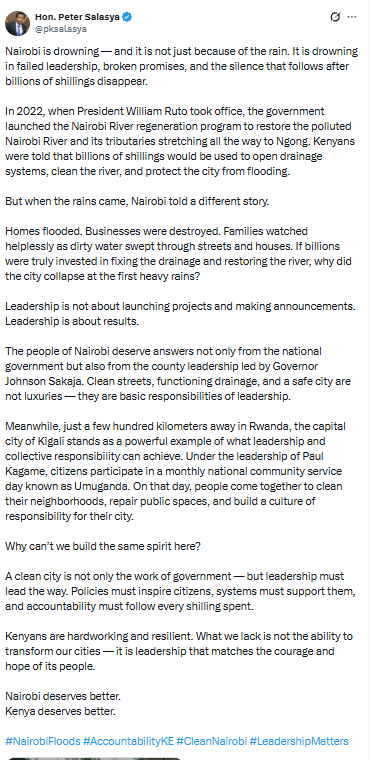
“Nairobi is drowning — and it is not just because of the rain. It is drowning in failed leadership, broken promises, and the silence that follows after billions of shillings disappear,” he said.
“In 2022, when President William Ruto took office, the government launched the Nairobi River regeneration program to restore the polluted Nairobi River and its tributaries stretching all the way to Ngong. Kenyans were told that billions of shillings would be used to open drainage systems, clean the river, and protect the city from flooding. But when the rains came, Nairobi told a different story.”

The MP questioned why the city experienced severe flooding despite the government’s investment claims in urban drainage and river restoration projects.
He said the flooding of homes, roads, and business premises during heavy rainfall raises serious accountability concerns regarding the utilisation of public funds.
“Homes flooded. Businesses were destroyed. Families watched helplessly as dirty water swept through streets and houses. If billions were truly invested in fixing the drainage and restoring the river, why did the city collapse at the first heavy rains?” he asked.
Salasya slams Sakaja
Salasya also called out the leadership of Governor Johnson Sakaja, stating that both the national and county governments must be held responsible for ensuring basic urban services.
He emphasised that clean streets, functioning drainage systems, and disaster preparedness are fundamental responsibilities of leadership rather than development luxuries.
The legislator pointed to Rwanda’s capital as an example of urban governance success, citing the community service programme implemented in Paul Kagame’s administration.

He referenced the monthly national community service initiative known as Umuganda, during which citizens participate in cleaning public spaces and maintaining infrastructure.
Salasya argued that Kenya could adopt a similar civic responsibility culture, noting that city transformation requires both government leadership and public participation.
“The people of Nairobi deserve answers not only from the national government but also from the county leadership led by Governor Johnson Sakaja. Clean streets, functioning drainage, and a safe city are not luxuries — they are basic responsibilities of leadership,” he said.
“Meanwhile, just a few hundred kilometers away in Rwanda, the capital city of Kigali stands as a powerful example of what leadership and collective responsibility can achieve. Under the leadership of Paul Kagame, citizens participate in a monthly national community service day known as Umuganda. On that day, people come together to clean their neighborhoods, repair public spaces, and build a culture of responsibility for their city. Why can’t we build the same spirit here?”
Nairobi flooding
The flooding crisis in Nairobi has displaced families, damaged property, and disrupted transport and water supply in several low-lying areas, prompting renewed debate about urban planning, drainage maintenance, and climate resilience strategies.
Authorities have continued to urge residents in flood-prone zones to remain alert as heavy rainfall is expected to persist in parts of the country.
Cabinet Secretary for Public Service, Human Capital Development and Special Programmes, Geoffrey Ruku, on Saturday, March 7, 2026, confirmed that 25 people have died following heavy rains across several counties.
Of the reported deaths, 21 were adult males, while four were children – two in Nairobi and two in Kitui County. Ruku extended his condolences to the families affected by the disaster.
“Currently, 25 deaths have been reported, comprising 21 male adults, 2 male children in Nairobi, and 2 male children in Kitui County. We convey our sincere condolences to the affected families,” CS Ruku announced.
The floods have hit both urban and rural areas, with Nairobi, Kiambu, Kajiado, Makueni, Nakuru, Migori, Muranga, Bungoma, Kwale, Kirinyaga, and Tharaka Nithi counties experiencing severe impacts.
Author
Mustafa Juma
View all posts by Mustafa JumaLatest News





Advertisement
More on News