Advertisement
Reuben Kigame warns of weaponisation of health sector and consumer products
Monday 29th December, 2025 07:35 AM|

Renowned gospel musician, human rights activist, and former presidential candidate Reuben Kigame has raised fresh concerns about the direction of the country’s health sector, warning that ordinary citizens should pay closer attention to decisions being made around healthcare, food systems, and public health policy.
In a statement shared on X on Sunday, December 28, 2025, Kigame linked the state of hospitals, changes in health insurance, and the safety of everyday consumer products to what he described as a wider pattern that Kenyans should not ignore. His remarks come at a time when health reforms, the future of SHA, and rising hospital costs continue to spark debate across the country.

Kigame stated that recent developments in the health sector go beyond routine reforms and deserve deeper scrutiny from the public.
“Kenyans need to pay attention to the weaponisation of the health sector by our government in conjunction with global players,” he wrote
You Might Also Like



He went on to point out what he described as deliberate weakening of public healthcare facilities, suggesting that the condition of some hospitals and changes in funding are not accidental. Kigame linked these concerns to broader policy shifts that have directly affected patients, especially those who rely on public hospitals and national health insurance.
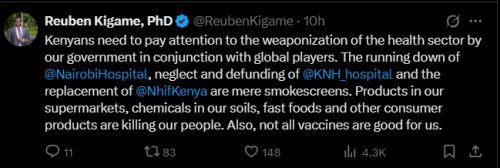
“The running down of Hospitals, neglect and defunding of some hospitals and the replacement of NHIF Kenya are mere smokescreens,” he wrote
Food and consumer safety
Beyond hospitals and insurance, Kigame expanded his warning to include food and consumer safety, saying that everyday products consumed by millions of Kenyans deserve urgent attention. He stated that what people eat and are exposed to daily could be contributing to serious health problems across the population.
“Products in our supermarkets, chemicals in our soils, fast foods and other consumer products are killing our people,” the statement reads

Kigame also touched on vaccines, urging Kenyans to question and seek information rather than accept everything without scrutiny.
“Also, not all vaccines are good for us,” he stated
Kigame suggested that a stronger oversight of hospitals, food safety, and public health decisions is needed, while urging caution and calling for reliance on scientific guidance. Kigame emphasised the importance of evidence-based policy, especially in areas touching on vaccines, food standards, and disease prevention.
Author
Latest News








Advertisement
More on News