Advertisement
ODM made my poll agency job difficult – Hassan
Tuesday 04th April, 2023 06:20 AM|
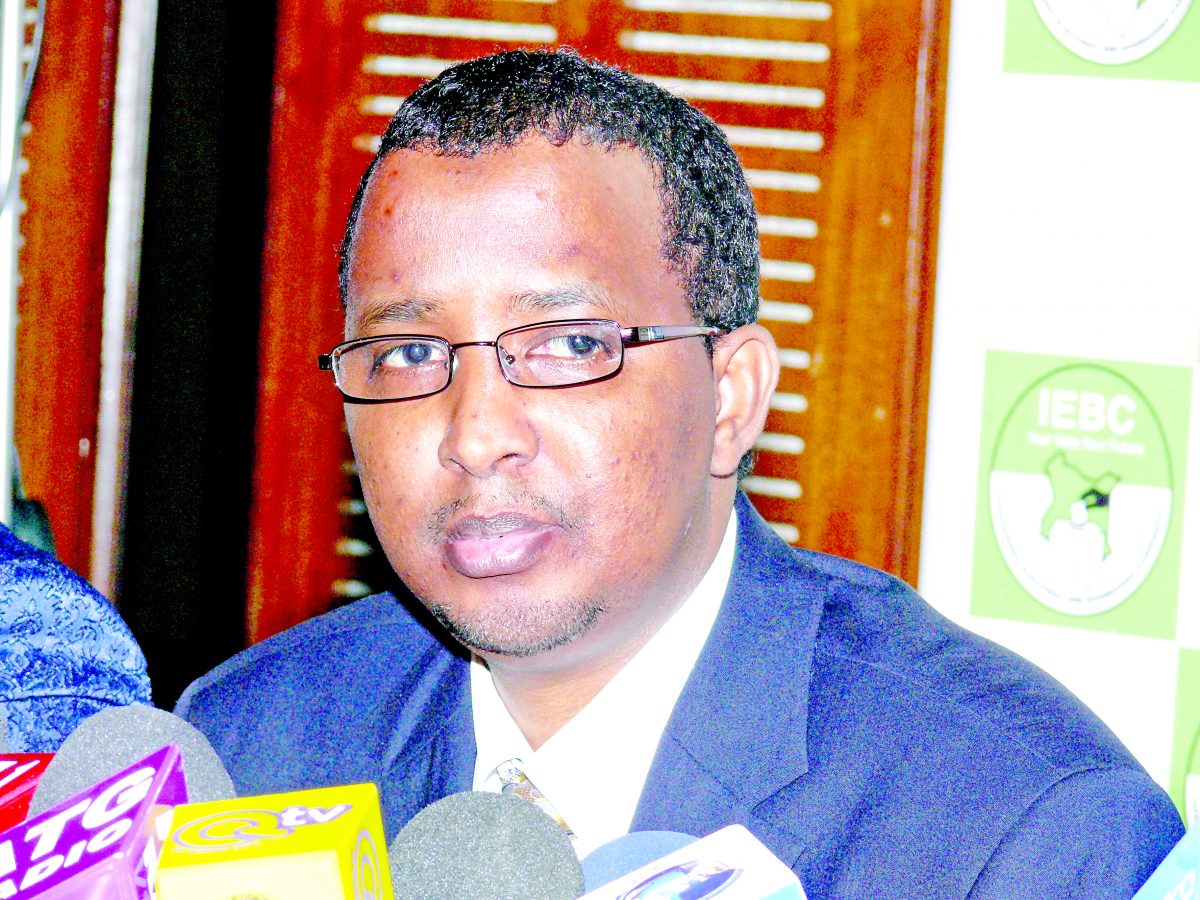
Former electoral commission chief Ahmed Issack Hassan has detailed troubles he encountered with Orange Democratic Movement (ODM) under the leadership of Raila Odinga during the time he was at the helm of the polls agency.
In his memoir, Referee of a Dirty Ugly Game: In the Theatre of Kenya’s Election, an Insider’s Account, Hassan has reveals numerous instances where he had to deal with cases of violence.
The memoir, published by Big Books Ltd, comes at a time Pwhen resident William Ruto and Raila have agreed on a ceasefire on the dispute over the August presidential election.
In his recollections about his stint at Anniversary Towers, first as Interim Independent Electoral Commission (IIEC) and later as Independent Electoral and Boundaries Commission (IEBC) chairman, Hassan says ODM behaved as if it was the opposition, despite the party being part of the Grand Coalition Government.
Scent of violence
The former polls agency chair says most ODM activities facilitated a state of lawlessness by making it easier for chaos and wanton destruction of property to take place.
“I couldn’t help but conclude that violence was in their DNA. Almost everyone joining the ODM brigade appeared to have been cut from the same cloth,” he says.
He adds: “The scent of violence was never too far away, and stirring up chaos had become their natural default setting. It was the first reaction when things did not go their way. They loved to spread fear and thrived on intimidating those who stood in their way.”
Nevertheless, Hassan says, despite the violence, he led a commission that could not be easily swayed by intimidations.
He says during an encounter with current Defence Cabinet Secretary Aden Duale, who was then MP for Dujis, he told him that he had to be tough.
“They found a chairperson who was not easily intimidated by their threats, and who did not quickly bow to pressure. I stood my ground on many matters that they would have bulldozed their way through, and this churned their anger. It was not lost on me that my character and responses reflected the perception people had of us, and that is how I behaved and personified the independence of the commission,” he says.
South Mugirango
In the 559-page memoir, which is being sold at Sh2,500, Hassan recalls his first encounter with chaos was during a by-election in South Mugirango. This was the first voting that IIEC conducted using the electronic transmission system.
The South Mugirango seat had been declared vacant by the then Speaker Kenneth Marende on January 15, 2010.
Omingo Magara had won in the 2007 election but his victory was cut short after the High Court nullified the results in December 2009 after it ruled that the election was marred by glaring anomalies.
In a clear case that chaos was beckoning, the by-election came at a time when clean up of the voter register had not been completed.
With the polls set for June 10, 2010, Hassan got intelligence that some political parties were planning to import voters to the constituency in an attempt to swing the results in their favour.
Keen to ensure the polls were fair, Hassan says he sent his team for thorough verification.
Security was also beefed up after a team from the General Service Unit (GSU) was deployed as an extra measure.
On the material day, Hassan says, ODM was confident of winning but things took a dramatic turn when Manson Nyamweya, who was vying on a Ford People ticket, appeared to take an early lead ahead of Ibrahim Ochoi of ODM.
It was at this time that Hassan says things started getting messy after then Lands Minister James Orengo, now Siaya governor, challenged the results.
Orengo was uncomfortable about the trend that he even stopped the live transmission of results. He says Orengo was backed by Anyang’ Nyong’o, now Kisumu governor.
“It seemed he did not want the loss of ODM’s candidate to be publicised. Should the results have been in their favour, however the live transmission would definitely have been warmly welcomed,” he says.
In Spite of the interference, Hassan says, ODM eventually conceded defeat.
Revoke nominations
Hassan also details a by-election in Makadara on September 20, 2010 where, he says, ODM politicians used intimidation to bulldoze their way.
However, Hassan says his firm stand made several politicians to embrace the culture of accepting the results.
“I came to realize later that political leaders in ODM had previously used intimidation and other similar tactics to bulldoze their way around anything. However, they were finding this new commission strange since it did not bow easily to their whims. I did not respond kindly to any unwarranted threats from anyone,” he says.
Hassan says his decision to revoke nominations of ODM councillors did not in any way improve his relationship with the party’s leaders.
In the book, Hassan narrates how his mother tried to persuade him not to apply for the IEBC job.
He says that his mother was so serious that she traveled all the way from Garissa to Nairobi to convince him not to apply for the job after she learnt that Raila was against his candidature.
However, Hassan says he remained firm and told his mother that he would go for the position.
The polls chief’s bad blood with party intensified following the ODM leader’s demand for his ouster from the commission.
In 2016, Raila who then led the Coalition for Reforms and Democracy (Cord) called for the immediate exit of commissioners to pave the way for a reconstitution of the polls agency.
He said Raila, Kalonzo Musyoka and other politicians, led demonstrations demanding their exit from IEBC.
He left the electoral agency after a Parliamentary Select Committee on electoral reforms decided that a new team be put in place to man the 2017 polls.
The tell-all book is set to be launched in Nairobi at the weekend.
Author
Alvin.Mwangi
View all posts by Alvin.MwangiLatest News




Advertisement
More on News