New LSK council pledges fight for judicial integrity and safe advocacy
By Kenneth Mwenda, April 15, 2026The Law Society of Kenya (LSK) has issued a strong warning about threats to the rule of law as its new council takes office.
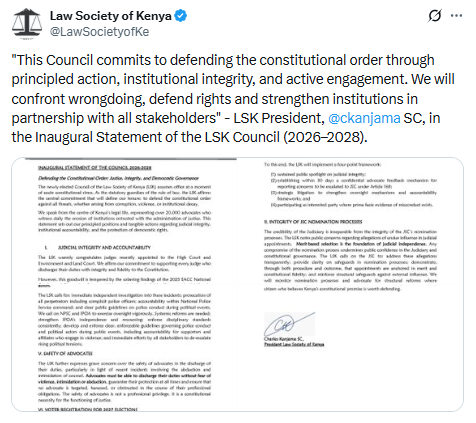
In its inaugural statement released on April 14, 2026, the council, led by President Charles Kanjama, pledged to defend Kenya’s constitutional order against corruption, violence and institutional decay.
The statement comes at a time of rising public concern over judicial integrity, police conduct and political tensions ahead of the 2027 elections.The LSK represents more than 20,000 advocates.
“We affirm the central commitment that will define our tenure: to defend the constitutional order against all threats, whether arising from corruption, violence, or institutional decay,” the statement reads.
Focus on judicial integrity
The council congratulated judges recently appointed to the High Court and the Environment and Land Court. It promised support for those who perform their duties with integrity. However, it tempered this goodwill with hard data from the 2025 EACC National Gender and Corruption Survey.
The survey showed judicial officers received bribes in 5.5 per cent of service interactions.
“Corruption in the Judiciary begets an existential threat to the Constitution itself,” the LSK stated.
“When justice is rationed by ability to pay, the rule of law becomes commodified and the Bill of Rights is rendered hollow.”
The society welcomed ongoing reforms by the Judiciary and the Judicial Service Commission but stressed that systems alone are not enough. Enforcement must follow.
It set out two clear principles. First, judges facing serious corruption claims who obtain court orders to suspend investigations should voluntarily step aside from judicial duties until the probes end.
“This is both an ethical imperative and an institutional necessity,” the statement said.
Second, the LSK rejected the use of transfers to hide incompetence or corruption. It called for full transparency in all judicial transfers, including publication of reasons, to rebuild public trust.
To drive change, the council announced a four-point plan. It includes sustained public focus on judicial integrity, a confidential advocate feedback system within 30 days to report issues to the JSC under Article 168, strategic litigation to strengthen oversight, and participation as an interested party where there is clear evidence of misconduct.
Concerns over appointments and police actions
The LSK turned its attention to the Judicial Service Commission’s nomination processes. It noted public worries about undue influence in appointments and insisted that merit must remain the foundation of judicial independence.
“Any compromise of the nomination process undermines public confidence in the Judiciary and constitutional governance,” it said.
The council will monitor future appointments and push for structural reforms where needed. On policing, the society expressed grave concern over the recent degazettement of Capitol Hill Police Station in Nairobi. It reminded authorities that the rule of law offers no special exemption for the powerful.
The LSK demanded a full transparent account of the decision, accountability for any breaches of due process or court orders, and protection of affected rights.
Condemnation of political violence
The statement condemned recent incidents in which goons, sometimes with reported police involvement, disrupted lawful political gatherings through violence and intimidation. It described such acts as “antithetical to the constitutional democracy we fought to build”.
The Constitution protects rights to assembly, association and expression, the LSK reminded readers.
“When police stand by as goons assault citizens or are deployed to disrupt political activity for partisan interests, they betray their oath. Police serve the Constitution and the people, not political actors,” LSK stated.
It called for immediate independent investigations, prosecution of all perpetrators including complicit officers, and clear guidelines on police conduct during political events. The society urged the National Police Service Commission and the Independent Policing Oversight Authority to act vigorously and pushed for systemic reforms to strengthen oversight and accountability.
Safety of lawyers and voter call
The LSK also raised alarms about the safety of advocates. Recent cases of abduction and intimidation of counsel have created fear.
“Advocates must be able to discharge their duties without fear of violence, intimidation or abduction,” it stated. Protection of lawyers is not a privilege but a constitutional necessity for justice to function.
Finally, with the 2027 General Elections approaching, the council urged all eligible Kenyans to register as voters.
“Democracy is not a spectator sport,” it declared. “The vote is the primary instrument through which citizens defend the constitutional order.”
It encouraged LSK members to lead registration drives in their communities and pledged support for civic education.
A call for vigilance
In conclusion, the council committed itself to principled action and active engagement with all stakeholders.
“The strength of our Republic will not be measured by the absence of challenges, but by the integrity of the institutions that confront them. The rule of law is not self-executing. It requires constant vigilance, institutional courage and collective action,” Kanjama said.