Advertisement
Will AI make Kenya’s youth rich or redundant? The World Bank has an answer
Saturday 13th June, 2026 12:45 AM|

The World Bank says artificial intelligence could reverse a decade of sluggish global growth and make the 2030s a boom era.
But it comes with a blunt warning: countries without digital infrastructure, AI skills, and the right regulatory environment will not just miss the boom; they will fall further behind.
A billion young Africans are heading into the job market at exactly the moment that artificial intelligence is rewriting the rules of employment.
Whether that collision produces prosperity or a new crisis may depend on decisions Kenya and its neighbours make in the next few years.
You Might Also Like



The World Bank’s Global Economic Prospects report for June 2026, released on June 11, 2026, devotes significant analytical attention to the AI question, and its conclusions are both encouraging and sobering in equal measure.
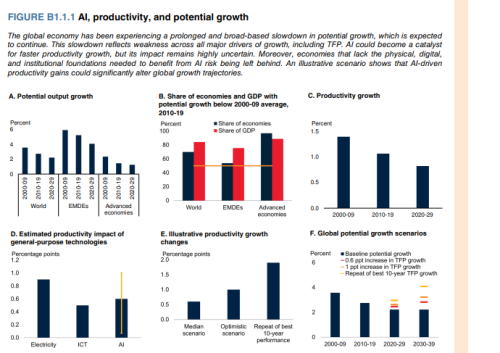
According to the findings, AI-driven productivity gains could push global growth in the 2030s above the average recorded in the 2000s, making that decade the strongest period of global growth since the 1970s. That is a remarkable possibility at a time when global potential growth is already sliding toward a three-decade low in the 2020s.
“AI could offer a path to reversing the prolonged slowdown in global growth. But only if productivity gains are large, persistent, and widely diffused,” the report states.
The preparedness gap
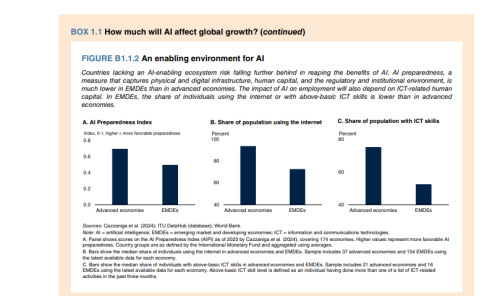
The World Bank is unsparing about what separates countries that will ride the AI wave from those that will be swamped by it. The report measures what it calls AI preparedness, a composite of physical and digital infrastructure, human capital, and the regulatory and institutional environment.
The gap between advanced economies and emerging markets is stark.
As of mid-2025, emerging and developing economies accounted for less than one-quarter of global data centre capacity. Low-income countries held less than 0.1 per cent.
Middle-income countries represent 40 per cent of global ChatGPT usage; low-income countries account for less than 1 per cent. Only one in four individuals in low-income countries used the internet as of 2022.
For Sub-Saharan Africa, the report flags that the region will see the largest increase in working-age population of any region globally between 2025 and 2035, part of the broader figure of 1.2 billion young people across all emerging markets set to enter the labour force over the next decade.

“The challenge of generating enough employment will be compounded by slower global growth and tight fiscal space amid technological change,” the report warns.
One of the report’s most important data points for Kenya’s policymakers and university planners is this: approximately 40 per cent of jobs in emerging and developing economies are exposed to AI, compared with 60 percent in advanced economies and just 26 percent in low-income countries.
This lower exposure partly reflects differences in industrial structure; economies with more agriculture, manufacturing, and informal services have fewer AI-susceptible white-collar jobs.
That sounds like good news. It is not entirely so. The World Bank is explicit that a smaller share of AI-exposed jobs does not mean safety; it also means slower diffusion of AI’s productivity benefits.
“This lowers the risk of labour market dislocations. but increases the risks of slower pro-growth diffusion of AI and a widening digital divide,” the report notes.
In other words, Kenya may be partly insulated from AI-driven job losses in the short term, but will also harvest fewer of the productivity gains that will power the economies that do invest. The countries that hesitate risk a new and durable gap with the world’s leading economies.
The coding economy opportunity
The World Bank report does identify a credible opening for Kenya and the EAC region. Digitally deliverable services exports have been the fastest-growing segment of global trade over the past decade, growing faster than goods exports or other services.
For a country with Kenya’s relatively strong university sector, growing technology hub in Nairobi, and established reputation in mobile money innovation, this is a lane that already exists.
The report also highlights the potential of small, lightweight, localised AI solutions that can operate on mobile devices with limited connectivity and do not require the enormous upfront capital costs of frontier AI models.
These solutions, it argues, could help smallholder farmers identify crop diseases, deliver customised tutoring to students, and support healthcare in remote areas. This is not Silicon Valley AI; it is AI built for Kenyan conditions.
“Job vacancies for workers with AI skills are rising faster in EMDEs than in advanced economies,” the report notes, though it immediately tempers this with the observation that only a small share of workers in EMDEs have above-basic digital skills.
Kenya’s universities and technical colleges face an urgent mandate to close that gap.
Author
Latest News








Advertisement
More on News