Advertisement
Uproar as Kenyans raise fresh concerns over missing details on IEBC portal
Tuesday 07th July, 2026 08:46 PM|

Fresh concerns have emerged over the Independent Electoral and Boundaries Commission (IEBC) voter verification portal after many Kenyans reported that their details were missing or had changed, prompting a wave of reactions on social media.
The complaints resurfaced on Monday, July 7, 2026, after users checking their voter details found that polling stations they had previously selected were no longer reflected on the portal. Others claimed their assigned polling stations appeared to have changed, while some could not see stream numbers.
The issue quickly became one of the most discussed topics online, with many questioning whether the changes would affect where they vote in the 2027 General Election.
Several Kenyans shared screenshots of their voter verification results, while others criticised the electoral commission over what they described as a lack of clear communication.
You Might Also Like



One social media user wrote, “Wameanua zangu pia… Hawa wakijua among my daily stresses ni venye nachange polling station itabidi warudishe.”
Another posted:
“Ama tunapiga kura Ol Kalou ndio maana hatuko kwa polling station zetu?”
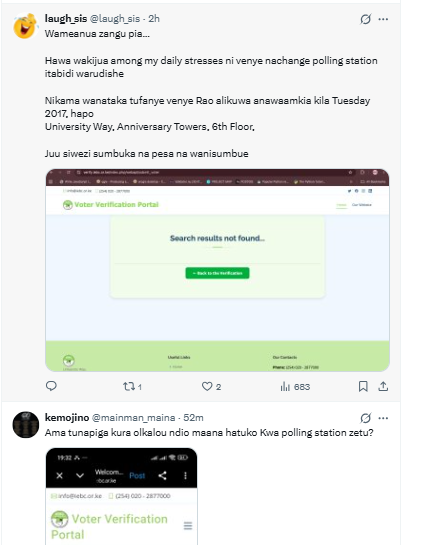
Others expressed concern that they could be forced to travel long distances to vote if the information remained unchanged.
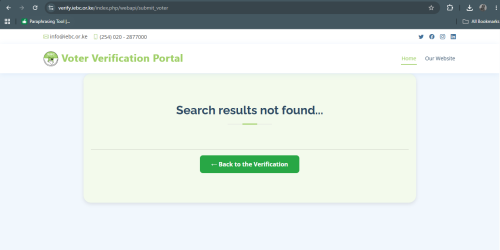
Portal errors spark concern
The latest reactions come just months after thousands of Kenyans encountered verification errors during the Enhanced Continuous Voter Registration (ECVR) exercise.
At the time, many newly registered voters received an error message stating:
“Voter with ID or passport provided is not found. If registered, visit your IEBC constituency office.”
The errors mainly affected new voters who had recently registered, leading to widespread frustration.
The commission later explained that the online portal was still being updated as voter registration continued.
In a public notice issued in April 2026, IEBC said the absence of polling station names or stream numbers did not mean that voters had been removed from the register.
The commission explained that, under Kenyan law, polling centres are divided into streams only after voter registration closes.
“The Commission, by law, splits registration and polling centres into polling stations (streams) of up to 700 voters only after the register is closed,” IEBC said.
It added that the process is carried out alphabetically by voters’ first names to ensure an even distribution across polling stations.
“Once voter registration concludes, the Final Register will be published with your specific polling station and stream number,” the commission stated.
Pre-2012 registration confusion
Earlier in 2026, the electoral body also came under criticism after confusion surrounding voters who had registered before 2012.
The commission initially stated that pre-2012 voters who were not captured under the biometric registration system needed to register afresh, triggering criticism from political leaders and civil society groups.
IEBC later clarified that only those who had never been enrolled in the biometric Register of Voters introduced in 2012 were required to register again.
Political leaders, including Wiper Party leader Kalonzo Musyoka, questioned the initial communication.
“They say anybody who voted before 2012 should go and register again. Do they not realise those same voters voted in 2013, 2017 and 2022?” Kalonzo said at the time.
People’s Liberation Party leader Martha Karua also criticised the directive, arguing that administrative challenges should not interfere with citizens’ constitutional right to vote.
Author
Kenneth Mwenda
Kenneth Mwenda is a business, sports, and politics digital writer with over seven years of experience in journalism, covering breaking news, feature stories, and in-depth analysis across a range of beats.
For inquiries, he can be reached at [email protected]
View all posts by Kenneth MwendaLatest News







Advertisement
More on News