Advertisement
Ndegwa Njiru advocates for voter-funded election model in Kenya
Sunday 11th January, 2026 11:07 AM|

Renowned Kenyan advocate and political commentator Ndegwa Njiru has sparked fresh debate on electoral reform by calling for the adoption of a voter-funded campaign financing model in Kenya, inspired by practices in Western democracies.
In a post dated January 11, 2026, on X, Njiru argued that shifting campaign funding from wealthy elites and special interests to ordinary citizens could fundamentally transform Kenyan politics.
“In the Western democracies, the voters finance their favourite candidate’s campaigns,” he wrote.
This approach, he explained, fundamentally alters power dynamics: “This model of campaign financing makes that candidate subordinate to the voter. The voter becomes the sovereign, while the elected leader becomes their servant.”
You Might Also Like

Njiru emphasised that such a system would promote humility and accountability among leaders. “This model humbles the leader and makes that leader more accountable to the people,” he stated.
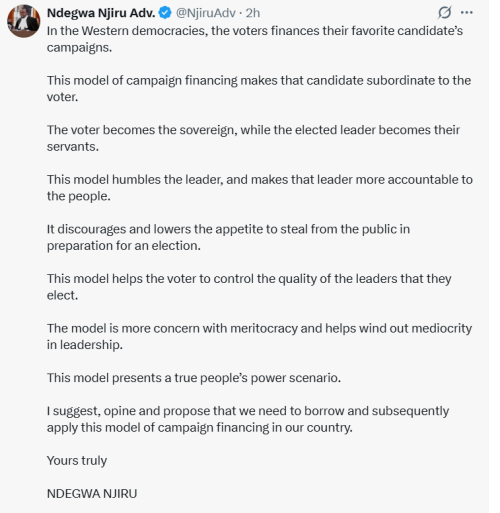
By relying on grassroots contributions, candidates would be less tempted by corruption. “It discourages and lowers the appetite to steal from the public in preparation for an election,” Njiru added, highlighting how the current reliance on big-money backers often fuels pre-election looting to recover campaign costs.
Empowering voters
Central to his proposal is empowering voters to shape leadership quality, adding that the model is also more concerned with meritocracy and helps weed out mediocrity in leadership.
“This model helps the voter to control the quality of the leaders that they elect,” he asserted. “The model is more concern with meritocracy and helps wind out mediocrity in leadership.”
Ultimately, Njiru framed the idea as a pathway to genuine democracy: “This model presents a true people’s power scenario.” He concluded with a direct appeal: “I suggest, opine, and propose that we need to borrow and subsequently apply this model of campaign financing in our country.”
Njiru’s advocacy comes amid growing public frustration over high-cost elections dominated by affluent donors, often linked to corruption and elite capture.
Examples from Western systems, such as small-donor matching funds in U.S. presidential primaries or democracy voucher programs in cities like Seattle, demonstrate how broadening the donor base can diversify candidate pools, reduce special-interest influence, and make officials more responsive to everyday citizens rather than wealthy patrons.
Author
Latest News








Advertisement
More on News