National, county governments reach resolutions to strengthen devolution
By Joel Masibo, December 10, 2025Kenya’s commitment to deepening devolution and strengthening collaboration between the national and county governments has been reaffirmed during the 12th Ordinary Session of the National and County Governments Coordinating Summit held at State House, Nairobi on Wednesday, December 10, 2025.
The Summit, the apex body for intergovernmental relations, brought together the National Government Executive and the Council of Governors, coordinated by the Intergovernmental Relations Technical Committee (IGRTC).
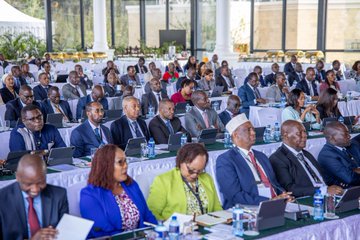
The session reviewed progress made since the 11th Summit held in December 2024 and charted a strategic path to accelerate the attainment of devolution’s objectives, particularly in service delivery, resource allocation, and intergovernmental coordination.
Highlights and resolutions
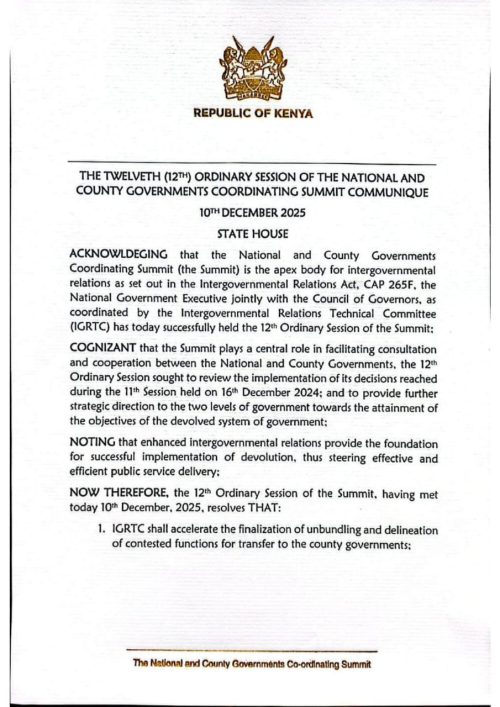
Accelerated transfer of functions to counties
The Summit resolved that IGRTC should fast-track the unbundling and delineation of contested functions for transfer to county governments. The Commission on Revenue Allocation (CRA) and the National Treasury will verify the financial implications of these functions ahead of their inclusion in the 2026/27 Division of Revenue Act.
County governments will further collaborate with state agencies to smoothen the transfer of fixed and movable assets associated with the devolved functions.
Strengthening legal and institutional frameworks
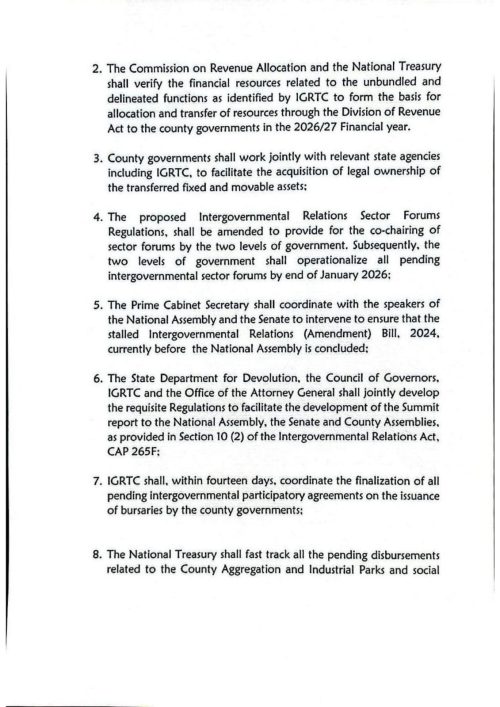
The Summit called for: Amendments to the Intergovernmental Relations Sector Forums Regulations to allow co-chairing by both levels of government, with operationalisation expected by January 2026. It also championed intervention from the Prime Cabinet Secretary and Parliament Speakers to conclude the long-stalled Intergovernmental Relations (Amendment) Bill, 2024. Also, the development of new regulations by the Office of the Attorney General, State Department for Devolution, IGRTC, and Council of Governors to guide the preparation of the Summit report to Parliament, as stipulated in law.
Financial efficiency and accountability
To streamline financial flows and improve service delivery:
The National Treasury will release county personnel emolument funds to County Revenue Fund Accounts by the 3rd of every month.
The Controller of Budget will expedite approvals to ensure counties meet statutory obligations by the 9th of every month.
Treasury will also fast-track pending disbursements for County Aggregation and Industrial Parks and related social infrastructure.
Health sector reforms
Several decisions were made to improve healthcare access and efficiency:
The Ministry of Health and Council of Governors will develop a framework for providing maternity services at Level 2 and 3 facilities by mid-January. These services will be funded through the Primary Health Care Fund (PHCF).
The Ministry will review the Persons with Disability Act, 2025 to harmonize medical service exemptions with the Social Health Insurance Act, 2023.
All existing NESP vendor contracts with zero installations will be canceled to pave way for new, effective vendors.
Community Health Promoters (CHPs) will receive timely stipends and will be covered under the PHC Fund.
Public finance management
The Summit noted the importance of further consultations on the Public Finance Management (Amendment) Bill regarding Section 191A-E. As a result, Treasury will withdraw the Bill from Parliament to allow more stakeholder engagement.
IGRTC has also been tasked with finalising all pending intergovernmental agreements on the issuance of bursaries by counties within 14 days, ensuring clarity, transparency, and standardised support for learners across the country.
At the same time, the National Treasury will fast-track all pending disbursements associated with County Aggregation and Industrial Parks to boost local manufacturing, agro-processing, and county-level economic growth.