Advertisement
National Assembly invites public views on Forest Conservation and Management (Amendment) Bill 2025
Thursday 16th April, 2026 12:58 PM|

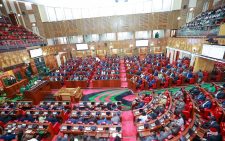
The National Assembly has invited members of the public to join them in formulating the proposed changes to the forest laws in the country under the Forest Conservation and Management (Amendment) Bill, 2025.
The invitation from the Directorate of Departmental Committees highlights Parliament’s intent to ensure inclusive lawmaking and governance of the environment through public participation.
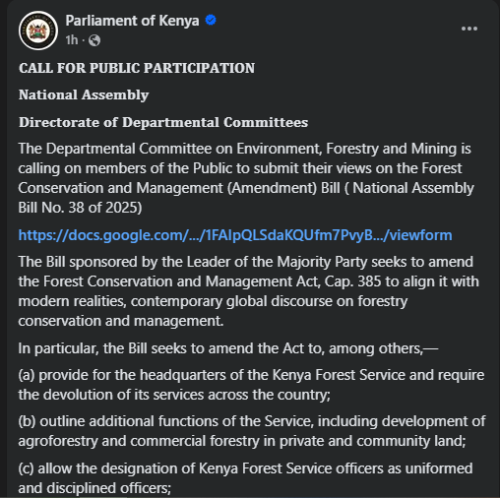
In a statement on their Facebook page on Thursday, April 16, 2026, Parliament has noted that the Departmental Committee on Environment, Forestry and Mining is soliciting opinions about the bill, which intends to amend the current Forest Conservation and Management Act (Cap. 385).
The Departmental Committee on Environment, Forestry and Mining is calling on members of the public to submit their views on the Forest Conservation and Management (Amendment) Bill (National Assembly Bill No. 38 of 2025,” Parliament stated.
You Might Also Like


The bill sponsored by the leader of the majority side, through the majority leader Kimani Ichung’wah, seeks to amend the Forest Conservation and Management Act, Cap. Parliament added that the bill seeks to amend the Forest Conservation and Management Act, Cap. 385, to align it with modern realities and contemporary global discourse on forestry conservation and management.
The proposed legislation aims to reconcile Kenya’s forest governance structure with changing national interests and international conservation and sustainable resource management trends.
Increasing Forest management
The Parliament, in its statement, has further noted that the main idea in the proposed amendments is to expand the mandate of the Kenya Forest Service. The bill suggests that the agency will play a more proactive role in advancing agroforestry and commercial forestry on the privately and community-owned lands, a move that is likely to increase the tree cover besides sustaining livelihoods.
The Bill also proposes steps to be taken to improve institutional capacity, such as the creation of the Kenya Forest Academy to improve training and research in the sector. It further suggests the formal designation of Kenya Forest Service officers as uniformed and disciplined staff, which would be a change to enhance enforcement and compliance initiatives.
The law also aims at decentralising forest services by explicitly establishing the headquarters of the Kenya Forest Service and increasing the service spread all over the country. This is meant to enhance access and effectiveness at the grassroots level in the management of forests.
Enhancing regulation and sustainability
The new regulatory frameworks proposed in the law are the establishment of the Office of the Director of Forest Regulation to monitor the standards and address accountability among forest sector stakeholders. This action will enhance regulation and control in managing forest resources.

As part of efforts to tackle the environmental issues related to arid and semi-arid areas, the bill focuses on ensuring that the dryland forests are managed sustainably through a combination of traditional practices and current conservation methods. It also gives the Kenya Forest Service the authority to provide easements in its public forests to allow the development of important infrastructure like roads and utilities, and it balances development pressures with conservation interests.
Moreover, the bill suggests more severe punishments for the crimes associated with the illegal importation, exportation, and reimportation of forest products, indicating a harder approach to the crimes against the environment.
The citizens have been asked to post their opinions on an online platform or by scanning a QR code given in the notice.
This is part of the constitutional mandate of Kenya that the masses participate in the legislative procedures in Kenya, thereby having a voice in the formulation of policies that affect the environment and development of the country.
Author
Latest News







Advertisement
More on News