Mvurya defends govt’s work mobility programme as senators seek stronger safeguards for Kenyans working abroad
By Ndiritu Wanjiru, June 12, 2026The government has been put under intense scrutiny in the Senate as lawmakers raise concerns over the protection of thousands of young Kenyans seeking employment opportunities overseas.
The parliament has noted that while appearing before the Senate Committee on Labour and Social Welfare on Friday, June 12, 2026, Cabinet Secretary for Youth Affairs, Creative Economy and Sports, Salim Mvurya, and officials from the Youth Enterprise Development Fund (YEDF) defended the programme, which has become a key pillar in the government’s efforts to address youth unemployment.
The session, chaired by West Pokot Senator Julius Murgor, focused on the programme’s effectiveness, accountability mechanisms, and safeguards against exploitation of Kenyan workers abroad.
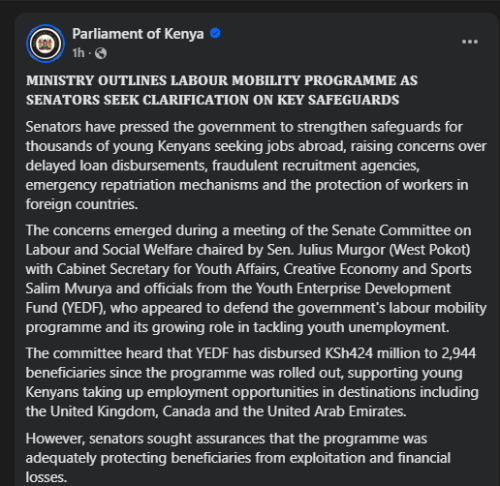
“Senators have pressed the government to strengthen safeguards for thousands of young Kenyans seeking jobs abroad, raising concerns over delayed loan disbursements, fraudulent recruitment agencies, emergency repatriation mechanisms and the protection of workers in foreign countries,” the Senate statement read.
Work mobility programme funding
According to YEDF, the fund has disbursed Ksh424 million to 2,944 beneficiaries since the initiative was launched, supporting young Kenyans taking up employment opportunities in countries such as the United Kingdom, Canada, and the United Arab Emirates.
Despite the programme’s growing reach, senators questioned whether adequate measures had been put in place to protect beneficiaries from financial losses, fraudulent recruitment agencies, and challenges faced while working overseas.
Nominated Senator Beth Syengo expressed concern over delays in loan disbursements, warning that prolonged processing periods could cause applicants to lose confirmed job opportunities abroad.
“What is the typical period between application and disbursement, and what mechanisms are in place to ensure applicants do not miss opportunities because of delays?” Syengo asked.
In response, YEDF officials said their service charter provides for loan disbursement within 14 days. However, they acknowledged that delays occasionally occur due to incomplete documentation submitted by applicants and liquidity constraints associated with the revolving fund model.
Cubbing fraudulent recruiters
Senators also sought clarification on the recovery of funds in cases where beneficiaries receive financial support but fail to travel.
YEDF officials explained that recruitment agencies are required to endorse applications and are contractually obligated to refund funds if travel arrangements fail to materialise. The fund further conducts follow-ups through phone calls, emails, and site visits and can initiate recovery through banking channels and securities provided by recruitment agents.
The committee also turned its attention to the issue of fraudulent recruitment agencies.
Kilifi Senator Stewart Madzayo demanded evidence of prosecutions against rogue recruiters accused of exploiting job seekers.
“Can you provide examples of cases where fraudulent recruiters have been prosecuted and indicate the outcomes?” Madzayo asked.
CS Mvurya told senators that the government has deregistered more than 1,000 fraudulent recruitment agencies as part of an ongoing crackdown. However, he noted that detailed prosecution records are maintained by law enforcement agencies and promised to submit comprehensive information to the committee.
The issue of Kenyans allegedly being recruited into foreign armed conflicts also emerged during the session.
Mvurya said the government was aware of such reports and had responded through diplomatic engagements, public awareness campaigns, and enhanced cooperation with foreign missions. He added that detailed records would have to be obtained from agencies responsible for immigration, security, and foreign affairs.
Senators Julius Murgor and Joe Nyutu further questioned whether the government had established an emergency repatriation mechanism for Kenyans facing distress while working abroad.
The CS clarified that YEDF does not operate a dedicated repatriation fund, explaining that emergency evacuations and welfare interventions are coordinated through the Ministry of Foreign and Diaspora Affairs, Kenyan embassies, and other government agencies.
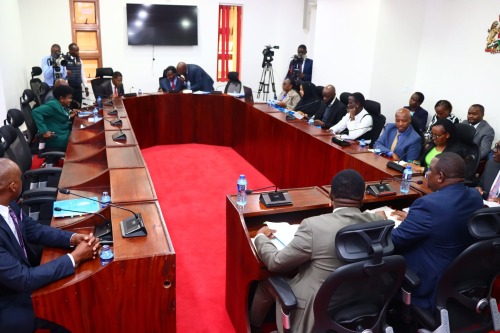
Committee members also sought assurances that embassy and consular services had improved in key labour destination countries.
Mvurya acknowledged past shortcomings but said the government had strengthened worker registration systems, enhanced engagement with labour attachés, and improved consular support for Kenyans working abroad.
Equality in the work mobility programme
Meanwhile, Murang’a Senator Joe Nyutu raised concerns over what appeared to be a higher uptake of the labour mobility programme in coastal counties compared to other regions.
He challenged the ministry to conduct a county-by-county analysis of applications and identify factors contributing to the disparities in participation.
The ministry committed to providing additional information on loan disbursement timelines, recovery of funds, prosecution of fraudulent recruiters, and regional uptake of the programme.
It also pledged to work with Parliament on legislative reforms aimed at strengthening oversight, accountability, and the protection of Kenyans seeking employment opportunities abroad.
The committee indicated that future oversight will focus on ensuring the labour mobility programme expands safely while safeguarding young Kenyans from exploitation as they pursue opportunities in foreign labour markets.