Advertisement
MPs spotlights growth in dairy sector in Embu and Tharaka Nithi counties
Saturday 18th April, 2026 08:31 AM|

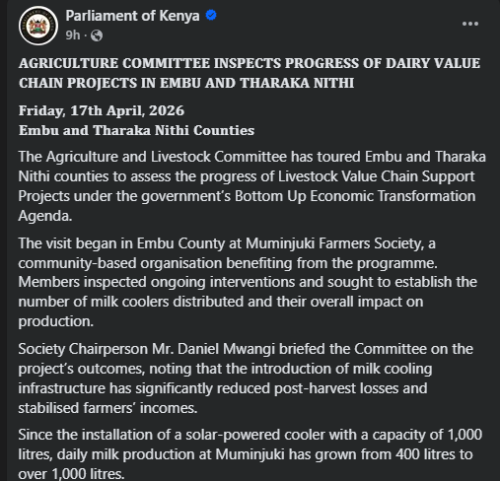
The National Assembly Agriculture and Livestock Committee has conducted an oversight visit to Embu and Tharaka Nithi counties, undertaking a tour of the implementation and the effects of the Livestock Value Chain Support.
Taking it to their social media handles on Friday, April 18, 2026, the parliament confirmed that during the visit, the committee looked at the current interventions, especially the installation and performance of milk-cooling infrastructure, to reduce post-harvest losses and increase farmer incomes.
“The visit began in Embu County at Muminjuki Farmers Society, a community-based organisation benefiting from the programme. Members inspected ongoing interventions and sought to establish the number of milk coolers distributed and their overall impact on production,” Parliament stated.
The introduction of a 1,000-litre solar-powered milk cooler has been a turning point for the group, according to the society chairperson, Daniel Mwangi, speaking to the committee. He observed that milk delivery has increased drastically in a single day by almost 400 litres to over 1,000 litres, mainly due to decreased spoilage and increased capacity of handling.
You Might Also Like


“With this cooler, which now serves 106 farmers, we no longer incur losses from milk spoilage and are now considering transitioning into a cooperative model,” Mwangi said.
Mwangi went on to state that the plant currently serves 106 farmers, and he also stated that the decline in losses has helped reinstate confidence in dairy farming and made more locals willing to enter the industry. He also foreshadowed moves by the members to formalise operations into a cooperative structure to increase efficiency and bargaining power.
MPs hail value addition
In his remarks, Matayos MP Geoffrey Odanga, who was among the delegates, praised the farmers who had adopted value addition and minimisation of wastage at the grassroots level. There were, however, concerns regarding the quality of animal food, where farmers argued that if they dealt with the issue of feeds, then their productivity was likely to increase even more. They also observed that a move to solar power has considerably alleviated the burden of operation, particularly electricity costs.
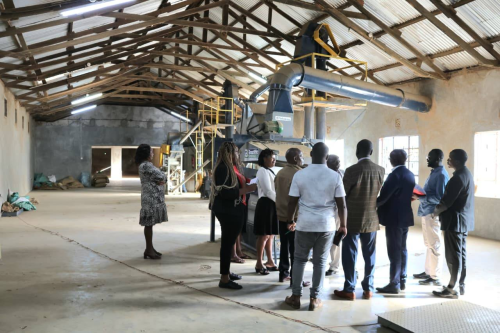
The committee then proceeded to Tharaka Nithi County, where they visited Kanja Dairy Cooperative Society, a major aggregation centre where milk was collected in some parts of Meru, Embu and Tharaka Nithi counties.
The cooperative is already dealing with a maximum of 15,000 litres of milk per day, but it is limited by a 5,000-litre cooling station. The committee was updated by the management that there is another 5,000-litre cooler being installed to relieve strain on operations.
Facility Manager Simon Njeru added that the cooperative has been enjoying the World Bank-funded Emergency Locust Response Programme (ELRP), which has helped the cooperative mobilise farmers, train on governance and digitise its operations by supplying computers.
MPs’ enquiries on enhanced milk quality standards
Lawmakers wanted to understand how new investments have enhanced efficiency and milk quality standards. In reply, Njeru clarified that milk is subjected to stringent lab tests before acceptance, such as bacterial content, antibiotic traces, heat retention, richness and freshness.
Although some progress has been made, the cooperative has identified a number of unresolved issues, with issues related to insufficient transport infrastructure being some of the major ones, making it difficult to collect milk in time. Officials emphasised that milk is perishable and therefore it is supposed to be processed within two hours after being collected from the farms to the plants to ensure that the quality is retained.
The high production costs are also a liability, and the cooperative mentions electricity bills of approximately Ksh100,000 per month and expensive transportation to the processors. Members also asked the government to come to their rescue in establishing a laboratory, milk tanker and investing in a feed and processing plant.
The cooperative also demanded more powerful extension services, improved farmer sensitisation, and more grassroots support to make the dairy value chain more sustainable and profitable to smallholder farmers.
Author
Latest News






Advertisement
More on News