MPs consider bill to regularise traditional medicine practitioners in Kenya
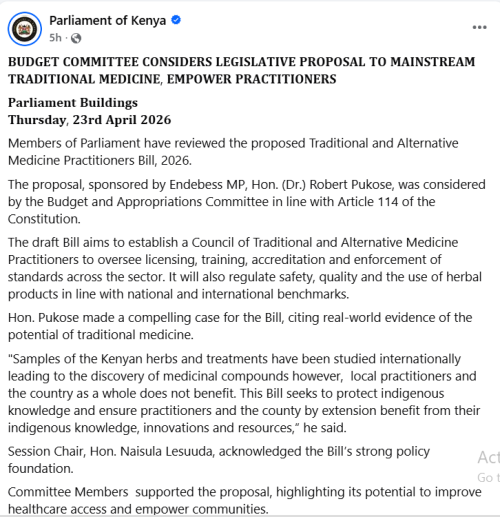
By Faith Lagat, April 24, 2026The Budget and Appropriations Committee is reviewing the Traditional and Alternative Medicine Practitioners Bill, 2026, which seeks to formalise and regulate Kenya’s traditional medicine sector through a structured legal and institutional framework.
Sponsored by Endebess MP Robert Pukose, the Bill proposes the creation of a Council of Traditional and Alternative Medicine Practitioners to oversee licensing, training, accreditation and enforcement of standards.
It also provides for regulation of safety, quality and marketing of herbal products in line with national and international standards.
Pukose told the Committee that the legislation is intended to ensure practitioners and the country benefit from indigenous knowledge.
“This Bill seeks to protect indigenous knowledge and ensure practitioners and the country benefit from their innovations and resources,” he said during the sitting on Thursday, April 23, 2026.
Regulatory framework
The Bill outlines the establishment of a governing council mandated to register and license practitioners in the traditional and alternative medicine sector. It further provides for training, accreditation and monitoring of compliance with set standards.
Members of the Committee noted that the framework is designed to introduce structure into a sector that largely operates informally. The proposal also includes provisions on safety monitoring, quality control and regulation of herbal product development and distribution.
The regulatory system is expected to align traditional medicine practice with existing health sector standards while introducing formal oversight mechanisms for practitioners.
Parliamentary consideration
Committee Chair Naisula Lesuuda noted the policy framework underpinning the Bill, while Members assessed its implementation structure and regulatory scope.
Florence Jematia highlighted the need for structured systems and alignment with national health policy. Christopher Aseka noted that formalisation could support standardisation of herbal treatments and expand economic opportunities, particularly in rural areas where many practitioners operate.
Lawmakers also noted that Kenya has an estimated 40,000 traditional medicine practitioners, many of whom provide primary healthcare services informally across the country.
Sector integration
The Bill is part of broader government efforts to integrate traditional, complementary and integrative medicine into the national health system. Existing policy documents include frameworks on practitioner accreditation, research coordination and product regulation under relevant health agencies.
The proposed law seeks to align Kenya with countries such as India and Tanzania, where traditional medicine has been integrated into formal healthcare systems under regulated standards.
The Budget and Appropriations Committee is expected to finalise its recommendations and table a report in the National Assembly for further debate.