Advertisement
More men than ladies give bribes to police officers, says EACC
Thursday 09th April, 2026 01:00 PM|

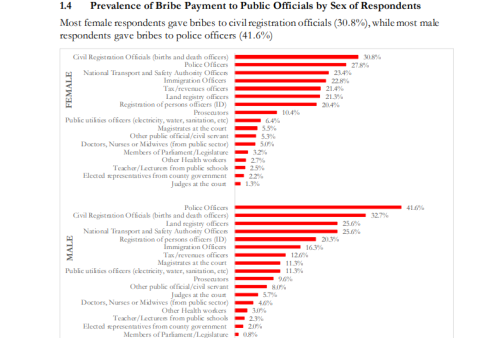
The Kenya National Gender and Corruption Survey 2025 shows that 41.6 per cent of male respondents paid bribes to police officers in the past 12 months.
For women, the figure stood at 27.8 per cent. Police officers topped the list of officials that men bribed.
Women, by contrast, paid bribes most often to civil registration officials, at 30.8 per cent. The survey, carried out by the Ethics and Anti-Corruption Commission with the Kenya National Bureau of Statistics, the National Gender and Equality Commission, Transparency International Kenya and the United Nations Office on Drugs and Crime, interviewed 16,858 adults across all 47 counties.
It focused on how Kenyans interact with public officials when they seek services such as IDs, birth certificates, driving licences and police assistance. Overall, 35.5 per cent of people who dealt with police officers said they paid a bribe. That made police the most bribe-prone public service in the country.
You Might Also Like


Civil registration officials came second at 30 per cent, followed by the National Transport and Safety Authority at 25.4 per cent.
Men handle most of the actual bribe payments even when women start the process, the survey found. Focus group participants explained why.
“Because women are usually at the forefront of family and home affairs,” one person in a Nairobi discussion group said. “They are the ones taking children to hospitals, managing household needs, and handling school matters. But when corruption comes into play, the people who engage in the negotiations, the bribes, or the deals are mostly men.”
Another participant in the same group added:
“Corruption affects women more than men. The reason is simple – women are usually at the forefront when it comes to seeking service delivery. If you look at the sectors that people often mention as the most corrupt – health and education – you’ll notice that women are the ones most exposed.”
Everyday bribes
The survey also recorded direct quotes from people who described how bribes work in practice. In Uasin Gishu, one person said:
“In practice, if you follow the normal process, it can take up to two weeks to get a birth and death certificate. But if you pay a bribe – often around 1,000 shillings, though the official fee is only 150 — you can get it the same day. Civil Registration Officers deliberately create delays so that people are forced to pay more.”
A participant in Kakamega described how some officers exploit ethnicity to demand cash.
“I worked at immigration… Sometimes you find there are some people just because they are called Ahmed, they will not be given passport. Their application will stay in the files. Someone decides they are not processing their passport so that they continue taking their money 50k, 20k.”
The average bribe paid to any public official rose to 6,724 shillings in 2025, up from 4,878 shillings the year before. Bribes to police officers formed a large part of that total. Men aged 18 to 24 paid the smallest average bribes overall, while those aged 65 and above paid the most. Rural residents handed over larger sums on average than people in towns. Most bribes – 84.3 per cent – were paid before the service was delivered.
Only 16 per cent were paid at the same time as the service. Cash remained the main method, used in 72.2 per cent of cases.The survey also looked at why people pay. Many said they simply wanted the service faster. Others felt they had no choice. When people refused bribes, the top reason was that they could not afford the amount asked.
Police officers saw the highest refusal rate, at 16.7 per cent of cases. Reporting rates stayed low. Only 30.2 per cent of those who paid or were asked for a bribe told the police.
Author
Kenneth Mwenda
Kenneth Mwenda is a business, sports, and politics digital writer with over seven years of experience in journalism, covering breaking news, feature stories, and in-depth analysis across a range of beats.
For inquiries, he can be reached at [email protected]
View all posts by Kenneth MwendaLatest News







Advertisement
More on News