Advertisement
Kakamega is the most corrupt county in Kenya, EACC says
Thursday 09th April, 2026 12:57 PM|

A new report by the Ethics and Anti-Corruption Commission (EACC) has ranked Kakamega as the county with the highest average bribes in Kenya, raising fresh concerns about corruption levels in public service delivery across the country.
The report, released on Thursday, April 9, 2026, is based on the Kenya National Gender and Corruption Survey 2025, a joint initiative involving EACC and several national and international institutions to better understand corruption patterns across counties.
The commission explained that the survey was designed to provide detailed data on corruption, including how it affects different groups, with a focus on improving policy responses through evidence-based findings.
The commission added that the new survey collected data from thousands of Kenyans across all counties using both quantitative and qualitative methods to give a more accurate picture of corruption.
You Might Also Like


“The Survey focused on citizens’ interaction with select public and private sector employees in delivery of services across all 47 counties,” the statement reads.
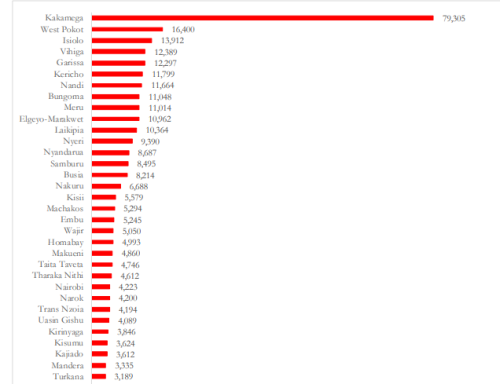
The findings revealed that Kakamega recorded the highest average bribe at Ksh 79,305, significantly higher than other counties, with large payments reportedly linked to judicial services.
“The top five counties with the largest average bribes were Kakamega (Ksh 79,305), West Pokot (Ksh 16,400), Isiolo (Ksh13,912), Vihiga (Ksh12,389), and Garissa (Ksh 12,297),” the statement reads.
The EACC report also identified counties with the lowest average bribes, pointing to wide disparities across the country in how corruption is experienced.
“The least average bribes were recorded in Kitui (Ksh 2,168), Siaya (Ksh 215), Nyamira (Ksh 1,655), Kilifi (Ksh 1,559), and Baringo Ksh1,314) counties,” the statement reads.
“The Kenya National Gender and Corruption Survey 2025 was carried out as a joint initiative between the Ethics and Anti-Corruption Commission; the United Nations Office on Drugs and Crime under the Programme for Legal Empowerment and Aid Delivery (PLEAD II), the Kenya National Bureau of Statistics (KNBS); the National Gender and Equality Commission (NGEC) and Transparency International, Kenya (TI Kenya),” the statement reads.
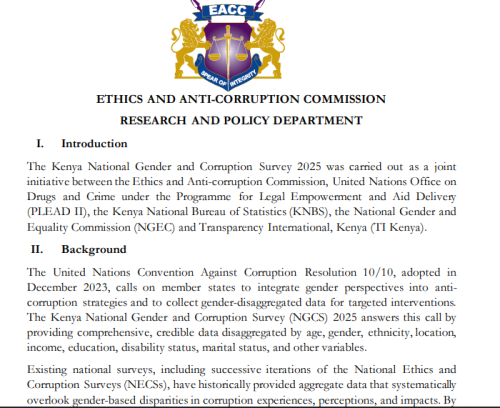
The report further noted that the survey responds to global calls for countries to integrate gender perspectives into anti-corruption efforts, while also collecting detailed data to guide interventions.
“The United Nations Convention Against Corruption Resolution 10/10, adopted in December 2023, calls on member states to integrate gender perspectives into anticorruption strategies and to collect gender-disaggregated data for targeted interventions,” the statement reads.
It also stated that previous surveys often treated corruption as affecting all citizens equally, which overlooked important differences in how people experience and respond to corruption.
“Existing national surveys, including successive iterations of the National Ethics and Corruption Surveys (NECSs), have historically provided aggregate data that systematically overlook gender-based disparities in corruption experiences, perceptions, and impacts,” the statement reads.
Author
Latest News




Advertisement
More on News