Advertisement
Maraga cautions on dangers of privatisation, demands transparency
Monday 13th October, 2025 08:39 PM|

Former Chief Justice and presidential aspirant David Maraga has criticised the recently passed Privatisation Bill 2025, calling it a threat to Kenya’s strategic public assets and urging full transparency and public oversight.
In a statement on Monday, October 13, 2025, Maraga said the Bill, which seeks to convert state-owned enterprises into private companies, bypasses constitutional requirements for public participation. He warned it could concentrate wealth in the hands of a few powerful individuals while undermining the public interest.
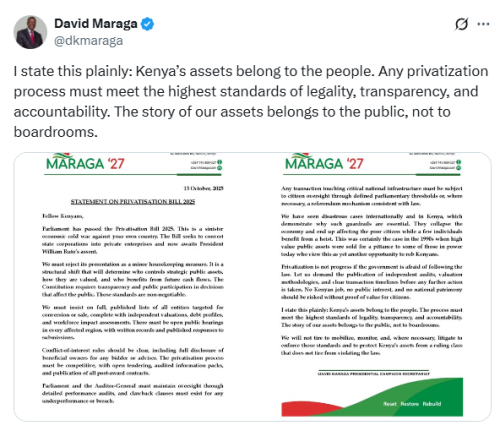
“Parliament has passed the Privatisation Bill 2025. This is a sinister economic cold war against your own country. The Bill seeks to convert state corporations into private enterprises and now awaits President William Ruto’s assent,” he stated.
“It is a structural shift that will determine who controls strategic public assets, how they are valued, and who benefits from future cash flows. The Constitution requires transparency and public participation in decisions that affect the public. Those standards are non-negotiable.”
You Might Also Like



He called for the publication of complete lists of all entities targeted for conversion or sale, with independent valuations, debt profiles, and workforce impact assessments. He demanded open public hearings in every affected region, with written records and published responses to submissions.
Also watch: Maraga warns public debt has gone haywire since 2013.
Conflict-of-interest rule
Maraga also stressed that conflict-of-interest rules must be enforced, including full disclosure of beneficial owners for any bidder or adviser. He insisted that the privatisation process must remain competitive, with open tendering, audited information packs, and publication of all post-award contracts.
“We must insist on full, published lists of all entities targeted for conversion or sale, complete with independent valuations, debt profiles, and workforce impact assessments. There must be open public hearings in every affected region, with written records and published responses to submissions.”
“Conflict-of-interest rules should be clear, including full disclosure of beneficial owners for any bidder or adviser. The privatisation process must be competitive, with open tendering, audited information packs, and publication of all post-award contracts.”
Also watch: List of 42 State corporations to be merged, 9 to be dissolved and 16 set for privatisation.
Parliament and the Auditor-General, he said, must maintain close oversight through detailed performance audits. He also recommended clawback clauses to address underperformance or breach of contract.
“Any transaction touching critical national infrastructure must include citizen oversight through defined parliamentary thresholds or, where necessary, a referendum mechanism consistent with law,” Maraga said.
Maraga pointed to past cases in Kenya and internationally to warn of the risks of poorly regulated privatisation. He recalled the 1990s, when high-value public assets were sold cheaply to individuals now in positions of power.
“Privatisation is not progress if the government is afraid of following the law. No Kenyan job, no public interest, and no national patrimony should be risked without proof of value for citizens,” he said.
Maraga concluded that Kenya’s national assets belong to the people and must be protected with the highest standards of legality, transparency, and accountability.
Muturi warns KPRL reform hides coastal land grab
Adding to the concerns, former Attorney General Justin Muturi said the government’s plan to dissolve the Kenya Petroleum Refineries Limited (KPRL) could mask a land grab in Mombasa. Muturi warned that once KPRL’s land and assets are transferred to the Kenya Pipeline Company (KPC) and later privatised, the property could end up in private hands.
“KPRL owns more than 400 acres of prime land in Nyali and Kilifi, facing the Indian Ocean. The government’s rush to dissolve the refinery is really about taking control of this land,” Muturi said.
He added that the facility could still be used for energy projects, such as biofuel processing or strategic crude reserves, and that its loss would reduce Kenya’s control over vital oil storage and logistics infrastructure.
Ruto defends privatisation
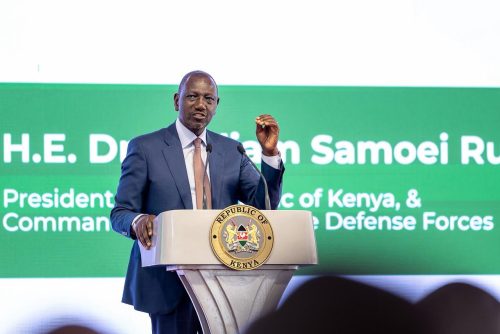
President William Ruto, meanwhile, defended the government’s plans, highlighting the role of privatisation in funding large-scale national projects. Speaking during the launch of Phase One Infrastructure at Konza Technopolis in Makueni County, Ruto said Kenya has the resources to transform into a first-world country and will pool funds from the budget, private investors, and privatisation proceeds under a proposed National Infrastructure Fund.
“And shortly, we will take to Parliament the law to establish a National Infrastructure Fund that will help us achieve these objectives,” Ruto said.
Author
Kenneth Mwenda
Kenneth Mwenda is a business, sports, and politics digital writer with over seven years of experience in journalism, covering breaking news, feature stories, and in-depth analysis across a range of beats.
For inquiries, he can be reached at [email protected]
View all posts by Kenneth MwendaLatest News




Advertisement
More on News