Advertisement
Muturi: KPRL reform is just land grab in disguise
Saturday 11th October, 2025 04:06 PM|

Former Attorney General Justin Muturi has raised concern that the government’s plan to dissolve the Kenya Petroleum Refineries Limited (KPRL) could open the door to the loss of prime public land in Mombasa.
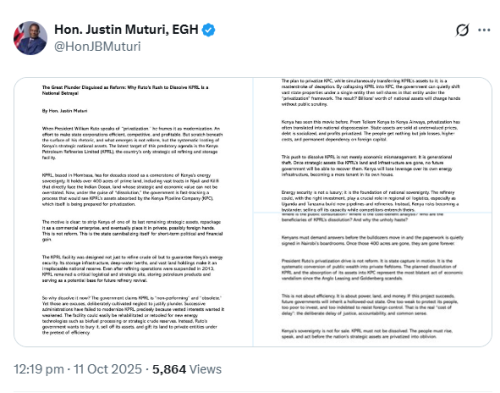
In a strongly worded statement titled “The Great Plunder Disguised as Reform,” posted on X on Saturday, October 11, 2025, Muturi said the government’s move to dissolve KPRL and transfer its assets to the Kenya Pipeline Company (KPC) is not about reform but about taking control of prime public land in Mombasa.
“KPRL owns more than 400 acres of land in Nyali and Kilifi, parts of which face the Indian Ocean. According to Muturi, this land is the real reason behind the rush to dissolve the state refinery,” he said.
“Once the land is moved under KPC, and KPC is later privatised, the property will end up in private hands.”KPRL, based in Mombasa, has for decades stood as a cornerstone of Kenya’s energy sovereignty. It holds over 400 acres of prime land, including vast tracts in Nyali and Kilifi that directly face the Indian Ocean, land whose strategic and economic value cannot be overstated.”
You Might Also Like



“Now, under the guise of “dissolution,” the government is fast-tracking a process that would see KPRL’s assets absorbed by the Kenya Pipeline Company (KPC), which itself is being prepared for privatization.The motive is clear: to strip Kenya of one of its last remaining strategic assets, repackage it as a commercial enterprise, and eventually place it in private, possibly foreign hands. This is not reform. This is the state cannibalizing itself for short-term political and financial gain.”
“Let us be blunt: the 400 acres of ocean-facing land in Nyali and Kili are the real prize. That land, in one of the most valuable coastal zones in East Africa, could fetch billions on the market. Once transferred to KPC, and once KPC is privatized, it will slip irretrievably out of public ownership. This is part of a larger, dangerous pattern.”
“President Ruto’s administration is pushing to privatize dozens of state corporations, from energy and infrastructure to finance and manufacturing. He calls it “unlocking value.” In reality, it is about liquidating public wealth to feed political cronies and foreign investors.”
Concerns grow over KPC sale
His comments come days after the government began the process of privatising KPC through an initial public offering (IPO) at the Nairobi Securities Exchange. The Privatisation Commission has already invited bids from firms to act as transaction advisors for the IPO, which is expected to be completed by March 2026.
The plan has raised concern from various quarters, including the Consumer Federation of Kenya (Cofek), which obtained a court order stopping the government from proceeding with the privatisation until a petition challenging the process is heard. Cofek argues that the sale lacks transparency and violates the constitutional requirement for public participation.
Muturi said the KPRL facility is not obsolete, as the government claims. He blamed past administrations for deliberately neglecting it to create a case for its closure.
“The refinery can still be upgraded or used for new energy projects such as biofuel processing or strategic crude reserves,” he said.
He warned that the loss of KPRL would undermine Kenya’s energy security and reduce the country’s control over vital oil storage and logistics infrastructure.
“Once this land and infrastructure are gone, no future government will be able to recover them,” he added.
Muturi also drew parallels with past privatisation programmes that led to the decline of major state firms.
“We saw it with Telkom Kenya and Kenya Airways. Assets were sold cheaply, jobs were lost, and the public got nothing in return,” he said.
He urged Parliament to resist the move and protect public property from being sold under the cover of efficiency.
The government, however, maintains that the privatisation of KPC will raise funds to support the national budget and give Kenyans a chance to buy shares in one of the country’s biggest enterprises. Officials also argue that listing the company will strengthen transparency and corporate governance.
Author
Kenneth Mwenda
Kenneth Mwenda is a business, sports, and politics digital writer with over seven years of experience in journalism, covering breaking news, feature stories, and in-depth analysis across a range of beats.
For inquiries, he can be reached at [email protected]
View all posts by Kenneth MwendaLatest News








Advertisement
More on Inside Politics