Advertisement
Kindiki links biodiversity protection to food security
Friday 22nd May, 2026 03:17 PM|

Deputy President Kithure Kindiki has linked biodiversity protection to Kenya’s long-term food security, climate resilience and public health, saying conservation remains critical to sustainable development and national stability.
Speaking on Friday, May 22, 2026, during the commemoration of the International Day for Biological Diversity at Tebe Grounds in Kapyego Ward, Elgeyo Marakwet County, Kindiki said environmental conservation directly affects agriculture, livelihoods and human well-being.
“Maintaining the natural environmental quantities of the world’s species of flora and fauna are intricately linked to our climate, our agriculture, our food security and even public health,” he said.
The event coincided with the official launch of the Cherangany Hills Ecosystem Restoration for Livelihood Improvement, Sustainability and Harmony (CHERISH) programme, a 10-year initiative valued at Ksh15 billion.
Government pushes restoration agenda
You Might Also Like


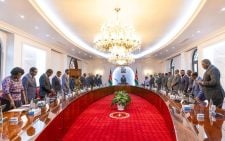
Kindiki said the government remains committed to protecting the constitutional right to a clean and healthy environment while accelerating ecosystem restoration programmes across the country.
He noted that the national tree-growing campaign targeting 15 billion trees by 2032 had already recorded progress, with 1.7 billion trees planted so far.
“The structural challenges that had affected the annual target for this programme have now been addressed to give way for acceleration of tree planting and growth,” Kindiki stated.
He added that restoration efforts in Kenya’s five major water towers Mt Kenya, Aberdare Ranges, Mau, Cherangany and Mt Elgon had gathered pace as part of wider environmental conservation efforts.
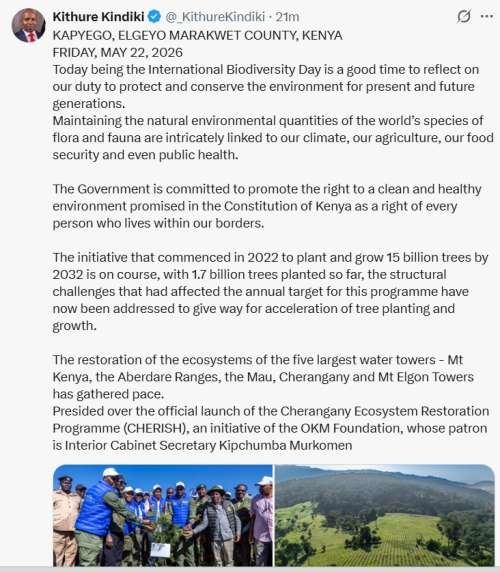
The CHERISH programme, launched under the OKM Foundation with Interior Cabinet Secretary Kipchumba Murkomen as patron, seeks to restore more than 60,000 hectares of degraded land, rehabilitate forests and wetlands, protect 20 springs and create approximately 500,000 green jobs through activities such as beekeeping, agroforestry and eco-tourism.
Murkomen links degradation to insecurity
During the launch, Murkomen said environmental degradation had contributed to recurring disasters and insecurity in the Kerio Valley region.
“These hills made me who I am. But I have watched this paradise slowly get degraded. The rains that were once predictable no longer are… Hillsides that were once green are now scarred,” he said.
Murkomen linked shrinking natural resources to conflicts and banditry in the region, noting that competition over water and grazing land continues to fuel instability. He said ongoing government disarmament operations had recovered more than 2,000 illegal firearms from the region.
The Cherangany ecosystem spans Elgeyo Marakwet, West Pokot, Trans Nzoia and Uasin Gishu counties and supports major rivers including Kerio and Turkwel. The ecosystem has experienced significant forest loss over the years due to agricultural expansion, logging and unsustainable land use practices.
Conservation, livelihoods and peacebuilding
The launch also featured the inaugural Cherangany Hills Peace and Conservation Race, which brought together participants from Pokot and Marakwet communities in an effort to promote peace and cohesion.
Olympic champion Faith Kipyegon served as race ambassador, while tree-planting activities were conducted at Embobut Forest as part of restoration efforts.
Kenya’s Ambassador and Permanent Representative to UNEP, Ida Odinga, who attended the event, said environmental restoration remains critical in addressing the root causes of conflict and promoting long-term peace.
The event comes as the government continues to respond to drought-related challenges affecting several parts of the country. The State Department for Special Programmes recently sought additional funding to support drought response measures amid rising humanitarian needs in arid and semi-arid regions.
Author
Latest News







Advertisement
More on News
