Advertisement
Kenya sets out plan to build billion-shilling date palm sector in ASAL regions
Thursday 11th December, 2025 12:10 PM|
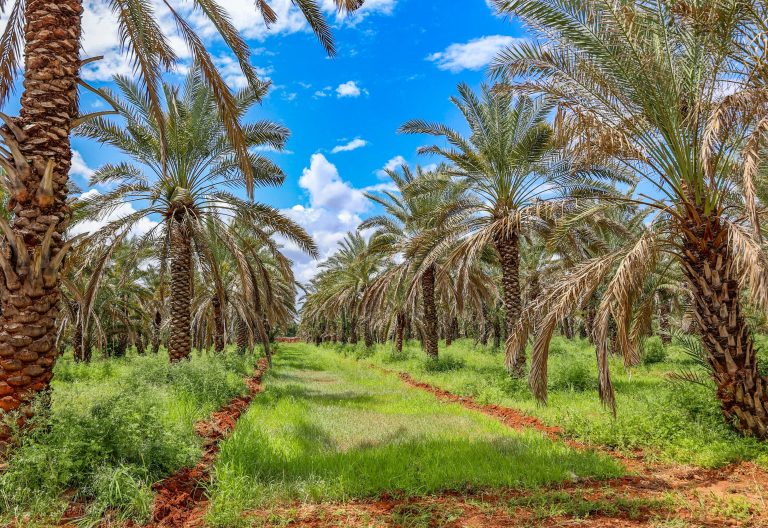
Kenya is moving to establish a billion-shilling date palm industry across its arid and semi-arid lands (ASALs) as national and county officials step up work to commercialise one of the world’s most profitable dryland crops.
In a high-profile visit to Kutch Farm in Kibwezi, Makueni County, Agriculture and Food Authority (AFA) Director-General Bruno Linyiru, Council of Governors Chair and Wajir Governor Ahmed Abdullahi, and technical teams from KEPHIS and KALRO inspected thriving Indian and Israeli date palm varieties.
The mission aimed to fast-track Kenya’s entry into the global date value chain, which is dominated by countries with similar climatic conditions.
Officials observed trees producing up to 200 kilogrammes each. They also reviewed the full production process, from selecting male and female palms to pollination, irrigation, harvesting, and value addition. The tour highlighted the crop’s strong commercial potential for Kenya’s drylands at a time when climate change is reshaping traditional farming systems.
You Might Also Like



Globally, dates are a multi-billion-dollar commodity led by Egypt, Saudi Arabia, Iran, Iraq, Algeria and the United Arab Emirates. These regions share the same heat and low humidity found in northern Kenya.
Yet Kenya produced only 1,100 kilogrammes of dates in 2023 and imported fruit worth more than Ksh 359 million in 2024, despite having suitable natural conditions. Officials say the gap shows how much the country stands to gain by investing in the crop.
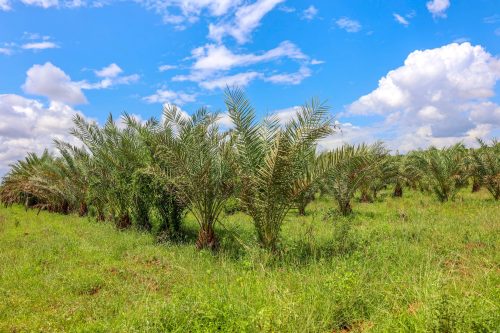
At Kutch Farm, the team studied an intercropping model where date palms grow alongside mangoes, pixies, oranges, okra and other crops. This approach increases land productivity and gives farmers a mix of income sources.
Date farming offers stability
Experts explained that date palms, when properly established and irrigated, can withstand extreme heat, tolerate saline soils and remain productive for decades. This makes them one of the most reliable long-term assets for households in dryland areas.
Counties such as Wajir, Mandera, Marsabit, Turkana, Garissa, Kitui, Tana River and Makueni are seen as strong candidates for commercial date farming. Officials believe the crop can stabilise family incomes, reduce drought risks and open new export opportunities.
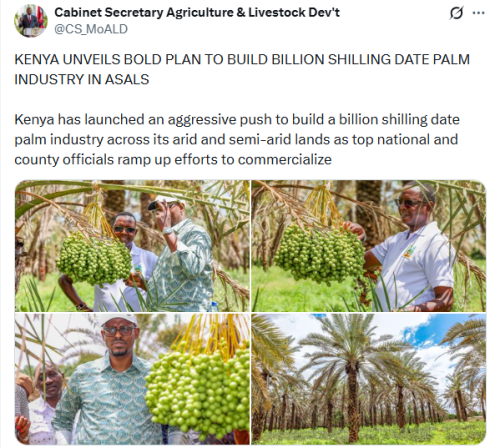
Linyiru said scaling up date palm production is now a national priority.
“As climate patterns shift, Kenya must diversify. Date palms are a high-value, drought-tolerant crop suited for ASAL regions. Our focus is to unlock quality planting material, strengthen value chains and support counties ready to scale,” he said.
The plan aligns with government efforts to promote high-value crops and with the Frontier Counties Development Council’s agenda. Premium varieties such as Medjool sell for up to Ksh1,200 per kilogramme on export markets.
A well-managed one-hectare date farm can earn between Ksh3.4 million and Ksh4.4 million per year once mature, offering a major boost to dryland agribusiness.
Author
Kenneth Mwenda
Kenneth Mwenda is a business, sports, and politics digital writer with over seven years of experience in journalism, covering breaking news, feature stories, and in-depth analysis across a range of beats.
For inquiries, he can be reached at [email protected]
View all posts by Kenneth MwendaLatest News








Advertisement
More on News