Advertisement
Kenya ranks among top countries with highest LPG use in Africa
Tuesday 30th September, 2025 08:32 PM|
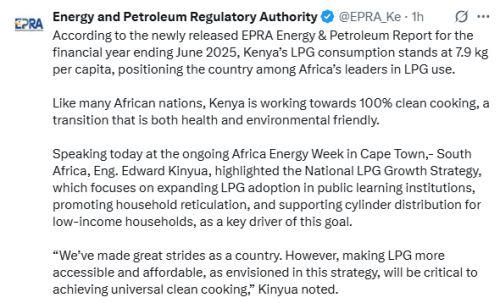
Kenya is emerging as one of Africa’s leading users of liquefied petroleum gas (LPG), according to the recently released Energy and Petroleum Regulatory Authority (EPRA) Energy & Petroleum Report for the financial year ending June 2025.
The report shows that the country’s LPG consumption stands at 7.9 kilograms per capita, a great increase in clean cooking adoption.
The push towards LPG forms part of Kenya’s broader goal of achieving 100 per cent clean cooking. Clean cooking protects the environment and improves public health by reducing indoor air pollution.
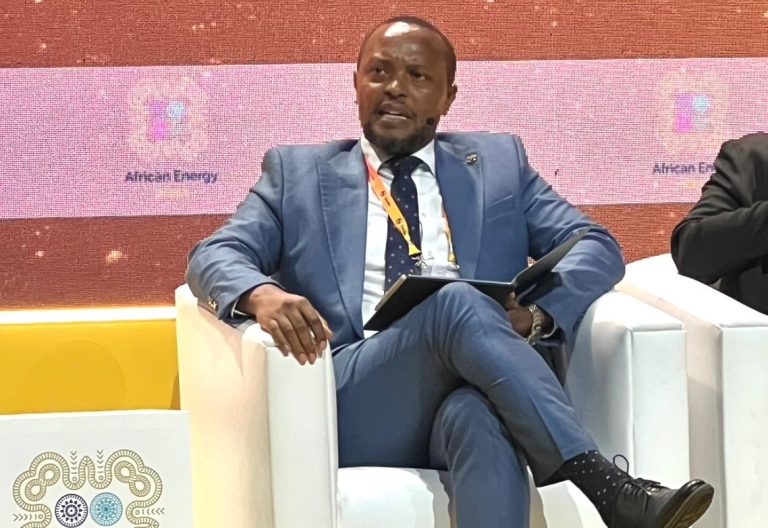
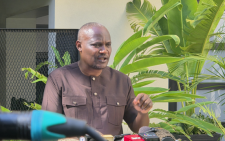
Speaking at the ongoing Africa Energy Week in Cape Town, South Africa, EPRA Chief Executive Engineer Edward Kinyua highlighted the National LPG Growth Strategy. This strategy focuses on several key initiatives, including expanding LPG access in public learning institutions, promoting household reticulation, and supporting cylinder distribution for low-income families.
You Might Also Like


“We have made great progress as a country,” Kinyua said.
“However, making LPG more accessible and affordable will be critical to achieving universal clean cooking.” The strategy aims to ensure that more households can safely switch from firewood and charcoal to LPG, which is faster, cleaner, and more convenient.
The EPRA report also highlights that Kenya’s total LPG consumption increased by 15 percent to 414,861 metric tonnes during the year. This growth reflects targeted interventions in households, schools, and autogas use.
Kenya’s power demand
Electricity consumption in Kenya also reached new highs during the same period. The report shows that the country recorded its highest peak demand in five years, reaching 2,316.2 megawatts.
Total electricity generation rose by six percent to 14,472 gigawatt-hours, with approximately 80 percent coming from renewable sources. Geothermal energy remained the largest contributor to Kenya’s renewable electricity, supporting the country’s transition to a low-carbon energy system.
On the demand side, households consumed 3,640.32 gigawatt-hours, a 13.03 percent increase, while small commercial consumers used 1,913.26 gigawatt-hours, up 11.5 percent. Street lighting also expanded significantly, and e-mobility usage tripled to 5.04 gigawatt-hours, reflecting growing adoption of electric vehicles.
Large consumers benefited from the Time-of-Use tariff, which allowed them to save approximately Ksh1.438 billion by shifting 180.3 gigawatt-hours of consumption to off-peak periods.
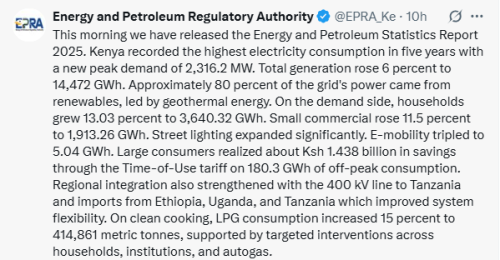
Regional integration strengthened as well, with the completion of the 400 kV transmission line to Tanzania and increased electricity imports from Ethiopia, Uganda, and Tanzania. These developments have improved system flexibility and helped meet growing energy demand across the country.
Author
Kenneth Mwenda
Kenneth Mwenda is a business, sports, and politics digital writer with over seven years of experience in journalism, covering breaking news, feature stories, and in-depth analysis across a range of beats.
For inquiries, he can be reached at [email protected]
View all posts by Kenneth MwendaLatest News







Advertisement
More on News