Advertisement
Judiciary reveals why Kenya’s courts introduced serialised claim forms
Saturday 04th July, 2026 12:20 PM|

The judiciary has introduced serialised claim forms as a safeguard against fraud and exploitation after reports emerged that some brokers were obtaining the documents and selling them to unsuspecting litigants at exorbitant prices.
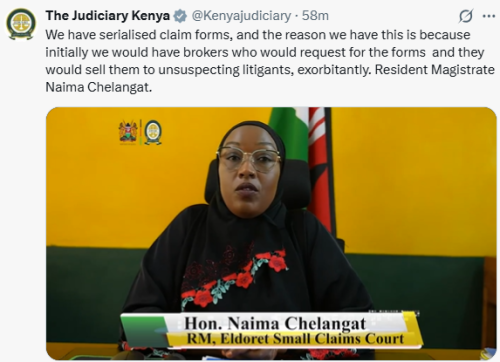
Speaking on the rationale behind the move in a video shared by the Judiciary on Saturday, July 4, 2026, resident magistrate at the Eldoret Small Claims Court, Naima Chelangat, explained that the serialisation of claim forms was designed to enhance accountability and ensure that court users access the documents through the proper channels.
“We have serialised claim forms, and the reason we have this is that initially we would have brokers who would request the forms, and they would sell them to unsuspecting litigants exorbitantly,” Chelangat said.
She noted that the practice had created an opportunity for unscrupulous individuals to profit from members of the public who were often unaware that claim forms are issued through official court processes.
Unique serial numbers on claim forms
You Might Also Like



According to the magistrate, assigning a unique serial number to every claim form allows the judiciary to track its distribution and use, making it more difficult for brokers to obtain large quantities of forms for illegal resale.
The measure is also intended to improve transparency and strengthen public confidence in the justice system by ensuring that litigants receive authentic court documents without unnecessary intermediaries.

Chelangat urged members of the public to obtain claim forms directly from court registries and avoid dealing with brokers or other unauthorised persons claiming to offer court services. She warned that using unofficial channels not only exposes litigants to financial exploitation but could also compromise their cases.
The judiciary has in recent years intensified reforms aimed at making justice more accessible, affordable and efficient. These efforts include digitising court services, strengthening case management systems and introducing safeguards to eliminate opportunities for corruption and exploitation.
Court users are encouraged to seek guidance from authorised court officials whenever they require assistance with filing claims or accessing judicial services, ensuring that they receive accurate information and avoid falling victim to fraudsters operating around court premises.
Author
Latest News







Advertisement
More on News