Hesbon Omollo: Nairobi’s core problem is poor urban planning
By Emmanuel Rono, March 10, 2026The recent floods in Nairobi have sparked a critical debate among experts and government officials about the city’s flood mitigation strategies.
Hesbon Omollo, an economist, while in an interview in a local station on Tuesday, March 10, 2026 has questioned the focus on resources alone and called for a more comprehensive approach based on planning and technology.
“To some extent, I will agree with the governor that resources have been a constraint, but I think that is a secondary issue, Nairobi flooding issue is primarily a planning issue,” Omollo said.

This comes following the allegations by Nairobi Governor Johnson Sakaja, who said that the flooding situation is primarily a matter of resources.
Sakaja, while appearing on Sunday evening, March 8, 2026, nearly 48 hours after floods caused widespread disruption across the city, highlighted the need for at least Ksh60 billion annually to properly address infrastructure needs, maintain public services, and respond to emergencies such as the ongoing floods in the city.
“I am not overwhelmed, I am under-resourced. Nairobi needs at least Ksh60 billion every year to address the challenges and development needs in a better way,” Sakaja stated.
However, Omollo argues that this is a secondary issue, emphasizing that the city’s flooding problem is primarily a result of poor physical planning.
Omollo points to Nairobi’s 2014 master plan as a crucial document that addresses various city issues, including flood-prone informal settlements.

He questions whether the governor is fully aware of this plan and how the $25 billion figure was determined.
“In 2014, Nairobi had a master plan that spoke to many issues around Nairobi; most of our informal settlements in the downstream areas are thoroughly exposed, but as a governor, you will be asked, do you understand what a master plan is? ”Omollo stated.
He added, “When you say you want 25billion, how have you accessed that?”
Leveraging Technology for Better Planning
Omollo suggests utilizing hydrological and hydraulic system reviews, evaluations, and simulations to understand how different rainfall levels impact the city’s drainage capacity.
He further stated that leveraging these technologies, Nairobi can anticipate and prepare for flood events more effectively.

This proactive approach would allow the city to develop targeted interventions and infrastructure improvements that address specific vulnerabilities.
“We have technology today, you can do hydrological and hydraulic system reviews or evaluations and simulations of what levels of rainfall are and how it exposes the county in terms of drainage,” Omollo said.
Deaths caused by floods
Heavy rains have hit Kenya hard, causing flash floods that the government says have killed at least 42 people across the country, with most of the deaths happening in Nairobi.
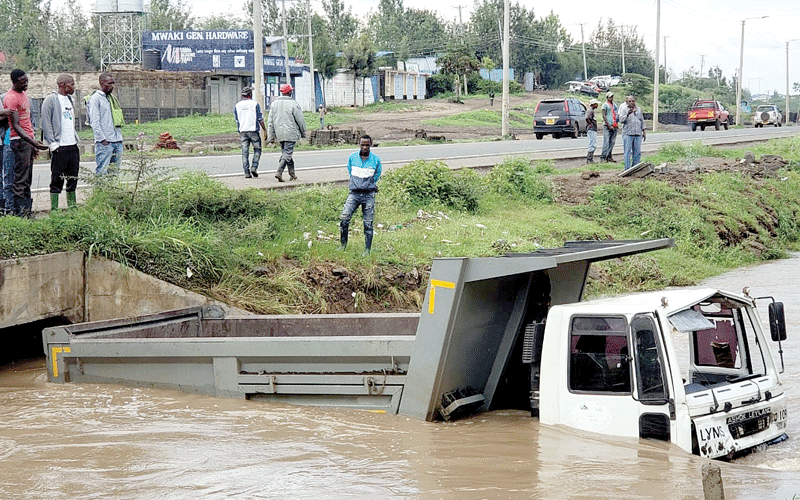
Officials said that 26 people died in the capital, where floodwaters covered whole neighborhoods, swept away homes and cars, and forced thousands of people to leave their homes.
In other counties, such as those in the Eastern, Rift Valley, Coast, and Nyanza regions, more deaths were confirmed as rivers overflowed and flooded low-lying areas.