Advertisement
Govt plans 6 mega dams as past failures raise doubts
Monday 26th January, 2026 08:36 PM|

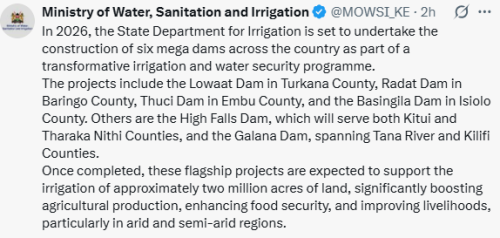
The government has announced plans to construct six mega dams starting in 2026, saying the projects will expand irrigation and improve food security, especially in arid and semi-arid areas.
The Ministry of Water, Sanitation and Irrigation made the announcement on January 26, 2026, claiming the dams will support irrigation across about two million acres of land.
“In 2026, the State Department for Irrigation is set to undertake the construction of six mega dams across the country as part of a transformative irrigation and water security programme,” the ministry stated.
The projects include Lowaat Dam in Turkana County, Radat Dam in Baringo County, Thuci Dam in Embu County, Basingila Dam in Isiolo County, High Falls Dam serving Kitui and Tharaka Nithi counties, and Galana Dam across the Tana River and Kilifi counties. Officials say the dams will boost agricultural production, improve livelihoods, and reduce the impact of drought.
You Might Also Like



However, past failures in large irrigation and dam projects have raised serious doubts about the plan. Kenya has a long record of stalled, cancelled, or poorly managed water projects that have cost taxpayers billions of shillings.
Scandals cloud mega dams
One of the most recent examples is the High Grand Falls Dam, which authorities cancelled in July 2025 after a flawed project evaluation. The cancellation of the Ksh337 billion project exposed the government to a possible penalty.
The project lacked transparency and risked costly legal disputes. Experts also warned that the design failed to consider downstream communities, increasing the risk of water shortages and environmental damage.
In September 2025, Wiper leader Kalonzo Musyoka accused President William Ruto of deliberately stalling the High Grand Falls Dam project, claiming that the head of state wanted to take over the contract for himself.

The proposed Galana Dam has also revived memories of the troubled Galana Kulalu irrigation scheme. Launched in 2014, the project aimed to turn one million acres into farmland. Instead, it collapsed due to poor planning, contractor failures, and weak oversight.
The government spent more than Ksh40 billion with little to show for it. A recent attempt to revive the project has drawn criticism from experts who question why authorities continue to push ideas that have already failed.
Earlier scandals still hang over the sector. The Arror and Kimwarer dams, cancelled in 2019 amid corruption investigations, left Kenya with billions of shillings in unpaid loans. Investigations showed how inflated contracts and graft turned the projects into financial losses, while local communities received no benefits.
Across the country, there are more than 500 stalled projects, representing over Ksh2 trillion in sunk costs. Many blame funding gaps, weak planning, and mismanagement. At the same time, unpaid court awards have risen, putting further pressure on public finances.
Kenya needs water infrastructure, but it also needs accountability. Without transparency, sound planning, and strong oversight, the new dam projects risk following the same path as earlier failures.
Author
Kenneth Mwenda
Kenneth Mwenda is a business, sports, and politics digital writer with over seven years of experience in journalism, covering breaking news, feature stories, and in-depth analysis across a range of beats.
For inquiries, he can be reached at [email protected]
View all posts by Kenneth MwendaLatest News







Advertisement
More on News