Advertisement
Govt guarantees adequate water supply in Turkana to support oil project
Friday 13th February, 2026 06:50 AM|

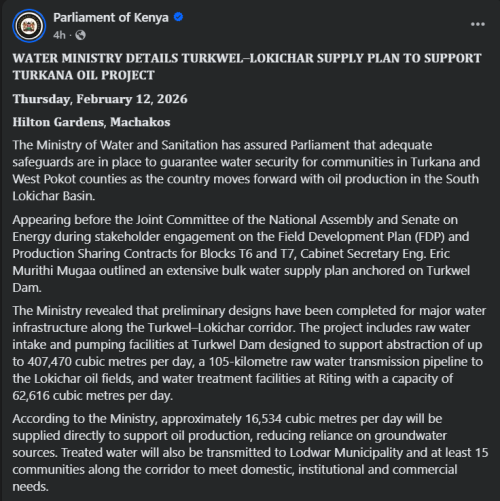
The Ministry of Water and Sanitation has assured that adequate measures are in place to guarantee water security for communities in Turkana and West Pokot counties as the country moves forward with oil production in the South Lokichar Basin in Turkana County.
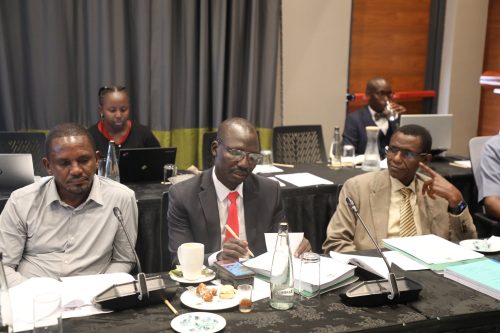
Appearing before a joint committee of the National Assembly and Senate on Energy during stakeholder engagement on the Field Development Plan (FDP) on Thursday, February 12, 2026, Cabinet Secretary Eric Murithi Mugaa outlined an extensive bulk water supply plan anchored on Turkwel Dam ahead of the Turkana oil project.
In a statement on their social media handles on Friday, February 13, 2026, the Parliament confirmed that the Ministry revealed that preliminary designs were complete for major water infrastructure along the Turkwel–Lokichar corridor.
“The project includes raw water intake and pumping facilities at Turkwel Dam designed to support abstraction of up to 407,470 cubic metres per day, a 105-kilometre raw water transmission pipeline to the Lokichar oil fields, and water treatment facilities at Riting with a capacity of 62,616 cubic metres per day,” the Parliament statement read.
You Might Also Like


According to the Ministry, approximately 16,534 cubic metres per day will be supplied directly to support oil production, reducing reliance on groundwater sources. Treated water will also be transmitted to Lodwar Municipality and at least 15 communities along the corridor to meet domestic, institutional and commercial needs.
The government further disclosed plans for large-scale irrigation development under the proposed Lower Turkwel Irrigation Scheme, targeting about 10,000 acres downstream of the dam. The irrigation component is expected to require 328,000 cubic metres per day and is aimed at boosting food security, supporting emerging oil settlements and promoting regional economic growth.
The Ministry further confirmed that the project has already received environmental approval from the National Environment Management Authority (NEMA), which issued an Environmental Impact Assessment licence in January 2025.
On concerns about tariffs, the Cabinet Secretary told the Parliament committee that no bulk water tariff framework had been approved. However, he assured lawmakers that operation and maintenance costs will be recovered through commercial bulk water sales to industrial users, including oil extraction operations. The North Rift Valley Water Works Development Agency will oversee the operation and maintenance of the bulk infrastructure and collect bulk water tariffs from oil operators and licensed water service providers.
To ensure transparency and accountability, the Agency will deploy automated monitoring systems, including SCADA technology, and establish dedicated technical, financial and monitoring teams. Distribution and customer management will be handled by licensed county water service providers.
Assurance on community safety
Addressing fears that increased abstraction could affect local communities, the Ministry said adaptive abstraction rules linked to dam water levels have been put in place. Water abstraction will only occur above 1,107 metres above sea level to safeguard the minimum level required for hydropower generation and long-term water sustainability.
The Ministry also cited additional projects aimed at strengthening regional water security, including the proposed Sigor Dam and Siyoi Murunyi Dam in West Pokot and Lowaat Dam in Turkana.
The Cabinet Secretary added that climate variability and drought risks have been taken into account in project design.
The water infrastructure is a key part of the commercial development of six oil discoveries in the South Lokichar Basin, as the government works to put Kenya’s oil production framework into operation while protecting community interests and long-term resource sustainability.
Author
Latest News







Advertisement
More on News